
2026-11-19
Outdoor Lights for House: Placement Questions
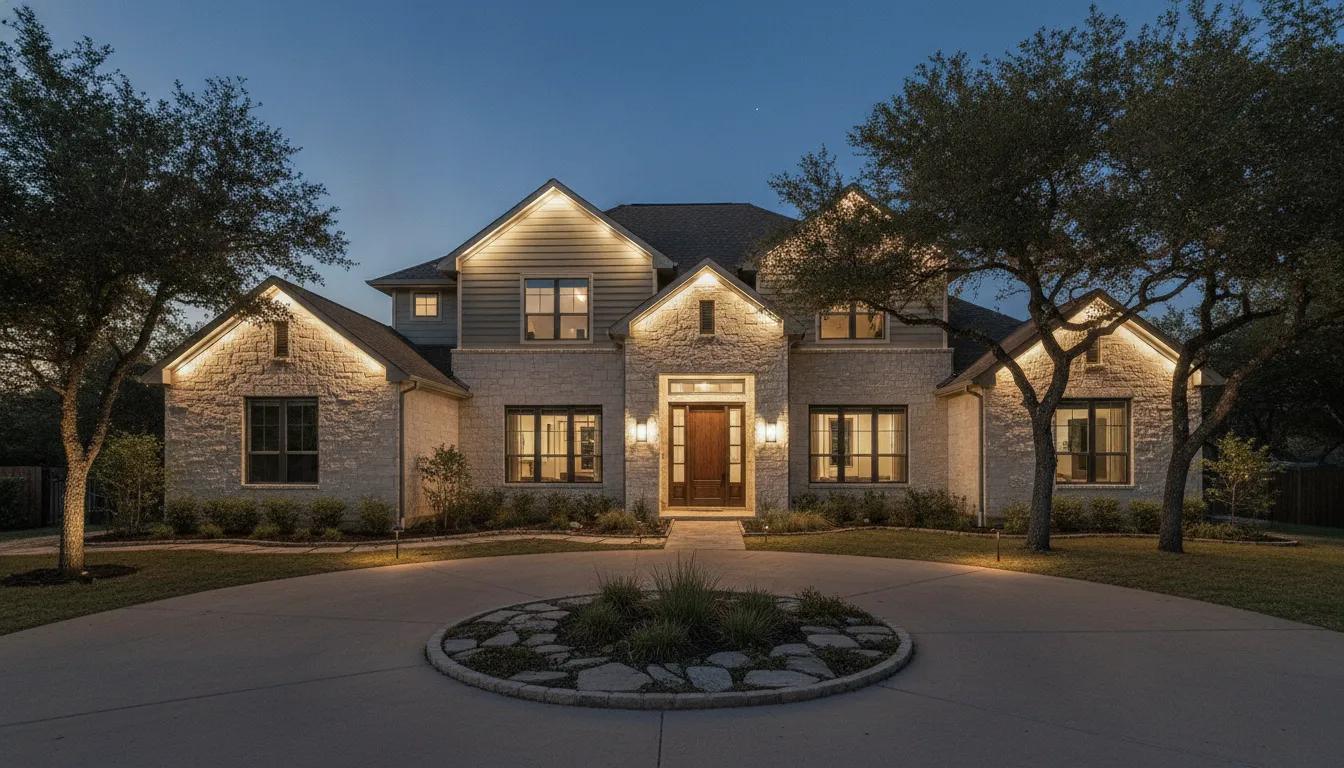
Outdoor lights for house projects get easier once you name the elevations and the nights you want them to work. A catalog of wall lanterns, path lights, and string sets will not tell you which roof edge belongs in the plan. The front eave, a side roof, and the patio edge are separate choices. LIT365 installs permanent soffit and roofline lighting in Austin, San Antonio, and Dallas. A quote starts with the property address and the areas you want lit.
Call (512) 988-3110 to plan outdoor lights for your house.
This guide is the placement brief, not a product roundup. It walks through the questions that change the scope of home outdoor lighting before anyone talks about a finished look. You will leave with a short list of elevations, uses, and photos to share. You will not leave with a citywide price, because LIT365 does not publish one.
What outdoor lights for house searches usually mix together
Search results for outdoor lights for house mostly show things you can buy: wall lights, landscape fixtures, solar stakes, and holiday strings. Those products solve a spot on the property. A roofline system solves a different job. It stays on the eaves and can change color, pattern, and schedule for holidays, game days, quieter nights, and patio time.
That mix is why placement questions come first. A path light near a walk and a low-profile run along the front soffit do not answer the same question, and buying one does not decide the other. If you are comparing a retail LED kit with a finished install, the LED house lights comparison covers that split. This article stays on where the light should go.
LIT365's lighting page shows four uses of one roofline: holiday color, game day, security visibility, and patio-zone ambiance. It does not ask you to buy four systems. The placement work is deciding which parts of the house need to carry those uses, and which parts can stay dark.
Start with the elevations you can actually see
An elevation is one face of the house: the street front, a side, or the rear. Permanent soffit lighting follows the roofline of the faces you choose. It does not float in the yard, and it does not light every tree by default.
Front elevation
The front is usually the first face to discuss, because it is the one neighbors, guests, and you see from the street or the driveway. Note the main eave, any porch roof, and whether a garage sits on the same line or steps forward. A simple front with one long eave is a different conversation from a front broken into several peaks.
Also note what you want that face to do on an ordinary Tuesday. Holiday color on the front is a common goal. Everyday visibility along the approach is another. Say which one leads, because the same hardware can do both, but the brief should not assume both.
Sides and rear
Side and rear eaves matter when you use those parts of the property after dark, or when the house is seen from more than the street. A corner lot, a long driveway, or a patio on the back can make a side elevation as important as the front. If you never see that face and do not gather there, leave it off the first list. You can add it later if the roofline and access allow.
Write the list in plain language: front eave only, front plus the patio side, or every elevation that faces a gathering space. That sentence is more useful than a fixture count.
Peaks, valleys, and more than one roofline
Roofline shape changes the plan more than a generic photo does. One continuous eave is not the same job as a house with several peaks, a forward garage, and a lower porch roof. Placement follows those turns. A run that looks even in a product photo can look unfinished if it stops in the middle of a peak you see every night.
Walk the property in daylight and mark three things:
- The eaves you want outlined, including porch and garage roofs if they read as part of the same face.
- Peaks and valleys that break a straight line, so the plan does not pretend the roof is one box.
- Places the hardware would be obvious in daylight, such as a low porch roof close to eye level.
LIT365 plans permanent soffit lighting around the architecture rather than a universal layout. Upper peaks, a front eave, and a side roof can each play a different role. You do not have to include every peak. You do need to say which ones you care about seeing after dark, and which ones should stay quiet.
If the house has several distinct roofs, say so in the first note. A guest cottage, a detached garage, or a deep porch is a separate roofline decision, not a footnote. The permanent soffit lighting page is where LIT365 describes that property-first scope. This article's job is to help you arrive with the roofs already named.
Match each elevation to a use
Placement and purpose belong in the same sentence. "Light the front" is incomplete until you name the nights that face should cover. December color, a Saturday game day, and a dim everyday wash are different briefs. You can want all three at different times. One installed roofline can support holiday displays, team color, useful exterior visibility, and patio ambiance. Those are settings and schedules, not four installs.
| Elevation you might name | Question to answer | What it changes in the brief |
|---|---|---|
| Street-facing eave | Is this for holiday color, everyday visibility, or both? | Which face leads the quote, and whether quiet nights matter as much as December |
| Porch or covered entry roof | Should this roof read with the main eave or stay separate? | Whether a lower roof close to eye level is in the run |
| Garage or side eave | Do you see this face from the driveway or only from the yard? | Whether a stepped roofline is included or left dark |
| Rear or patio edge | Do you gather here after dark? | Whether patio ambiance is in scope or the plan stops at the street face |
| Upper peaks | Do those peaks read from the street at night? | Whether the outline includes the high roof or only the eaves you live under |
Use the table as a filter, not a menu you must complete. A house that only needs the front eave for holidays is a valid plan. A house that also hosts people on a rear patio needs that elevation named, or the quote will describe a smaller project than you pictured.
Game day is a schedule, not a second roofline. If team color matters, say which faces should carry it. Security visibility on the LIT365 site means useful exterior light on ordinary nights, not a claim about cameras or crime. Patio ambiance means the gathering edge you actually use. If gutters on those same eaves also need work, the quote form can note lighting, gutters, or both. Gutter work routes to sister brand TX Gutter Solutions.
Sightlines decide what "enough" means
Two houses with the same roof length can need different outlines because people see them from different places. Stand in the spots that matter before you write the brief.
- Stand at the curb or the end of the driveway and note which eaves and peaks you notice first.
- Stand at the front door and see whether the porch roof blocks the main eave or reads as its own line.
- Stand on the patio, or wherever you sit after dark, and note the roof edge in that view.
- If a side yard is part of the arrival, walk it once and mark only the eaves you can see.
Those four stops keep the plan tied to use. A peak that looks important on a satellite view may disappear behind a tree from the street. A low eave over a seating area may matter more than a tall roof you never look at. Photos from those same stops help the quote conversation, but they do not replace the service address. LIT365 starts with the address, then the elevations.
Daylight matters too. Permanent hardware stays up in January and in July. Low-profile soffit placement is meant to stay quiet when the lights are off. If a particular eave sits close to a window or a porch ceiling you look at every morning, say so. The goal is an intentional line, not a track you notice before you notice the house.
What to gather before you ask for a quote
LIT365 does not publish a citywide price or a per-foot rate. Scope follows the address, the elevations you want discussed, the roofline and sightlines, and how you plan to use the lights. A clearer brief does not invent a number. It keeps the site-specific quote pointed at the house you have.
Property facts
Start with the service address in Austin, San Antonio, or Dallas. The service area check is the market context. Exact coverage is confirmed from the address, not from a mile radius this site does not publish. Note whether the property is a home or a business. Homes are the usual reader of a house-lighting search. Businesses can use the same roofline approach, but the faces and hours differ.
The placement list
Bring the elevation list from the sections above, in a few sentences. Include porch, garage, and rear only if you want them considered. Mention peaks you want in the night view and peaks you want left alone. Mention access notes you already know, such as a steep roof, a locked side yard, or landscaping tight to the eaves. You do not need measurements. The address and the list tell the conversation where to look.
Uses and timing
Say whether holiday color, game day, everyday visibility, patio ambiance, or some mix is the point. Say the season or event you care about if timing matters. Photos of the faces you listed are optional and useful. The contact form also asks for your name, phone, and email, and whether the request is lighting, gutters, or both.
If you are still deciding between a permanent roofline and temporary strings, settle that before you spend time on elevations. The permanent lights and string lights comparison is the decision guide. Once you know you want hardware that stays, come back to placement.
Installation itself is a later step. Permanent lighting installation describes how LIT365 moves from the property details to a roofline that stays in place. You do not need to plan the mounting. You need to plan the ask.
A short placement checklist
Use this order when the choices start to blur. It keeps outdoor lights for house planning tied to the building instead of a shopping cart.
- Name the faces you see and use: front, sides, rear, porch, garage.
- Mark peaks and separate roofs that should be in the night outline, and those that should not.
- Pair each included face with a use: holiday, game day, everyday visibility, patio, or a mix.
- Check the view from the curb, the door, and the place you sit outside.
- Note anything that makes an eave hard to reach, without guessing at a price.
- Confirm the property is in Austin, San Antonio, or Dallas, then send the address with that list.
That is the whole pre-quote job. Special cases, such as a two-story stair, a historic facade, or a home with no eaves, need their own plans and should not be forced into this checklist. For a typical house, the missing piece is usually the elevation list, not another product tab.
The installation gallery shows representative LIT365 work so you can see how a finished roofline reads at night. Treat it as a look at placement on other properties, not as a template for your roof. Your quote still starts from your address.
When the elevations and uses are clear, send the property address for a quote. Prefer to talk? Call (512) 988-3110 for Austin. San Antonio is 210-716-7750, and Dallas is 682-259-4438.
Frequently asked questions
What should I decide before I shop for outdoor lights for a house?
Decide which elevations you want considered and what those elevations should do. A front eave for holiday color is a different brief from a front plus a patio edge for everyday use. Products such as path lights and wall lanterns do not answer that roofline question.
Do I need lights on every side of the house?
No. Include the faces you see and use. Leave off eaves that do not matter at night. LIT365 scopes permanent soffit lighting from the elevations you ask about, not from a rule that every roof edge must be lit.
Can one roofline cover holidays and ordinary nights?
Yes. LIT365 describes one installed roofline for holiday color, game day, security visibility, patio ambiance, and everyday outdoor living. Tell the quote which of those you want, and on which faces. They are uses of the same system, not separate installations.
How much do outdoor lights for a house cost?
LIT365 does not publish a citywide price or a per-foot rate. The scope depends on the service address, the elevations you want lit, and the uses you describe. A placement list makes that quote specific. It does not produce a number this article can print.
What do I send with a quote request?
Send the property address, whether it is a home or a business, the elevations you want discussed, and how you want to use the lighting. Photos help. The form is at the contact page, and each city has a phone line if you prefer to talk.