
2026-10-19
LED House Lights: What to Compare
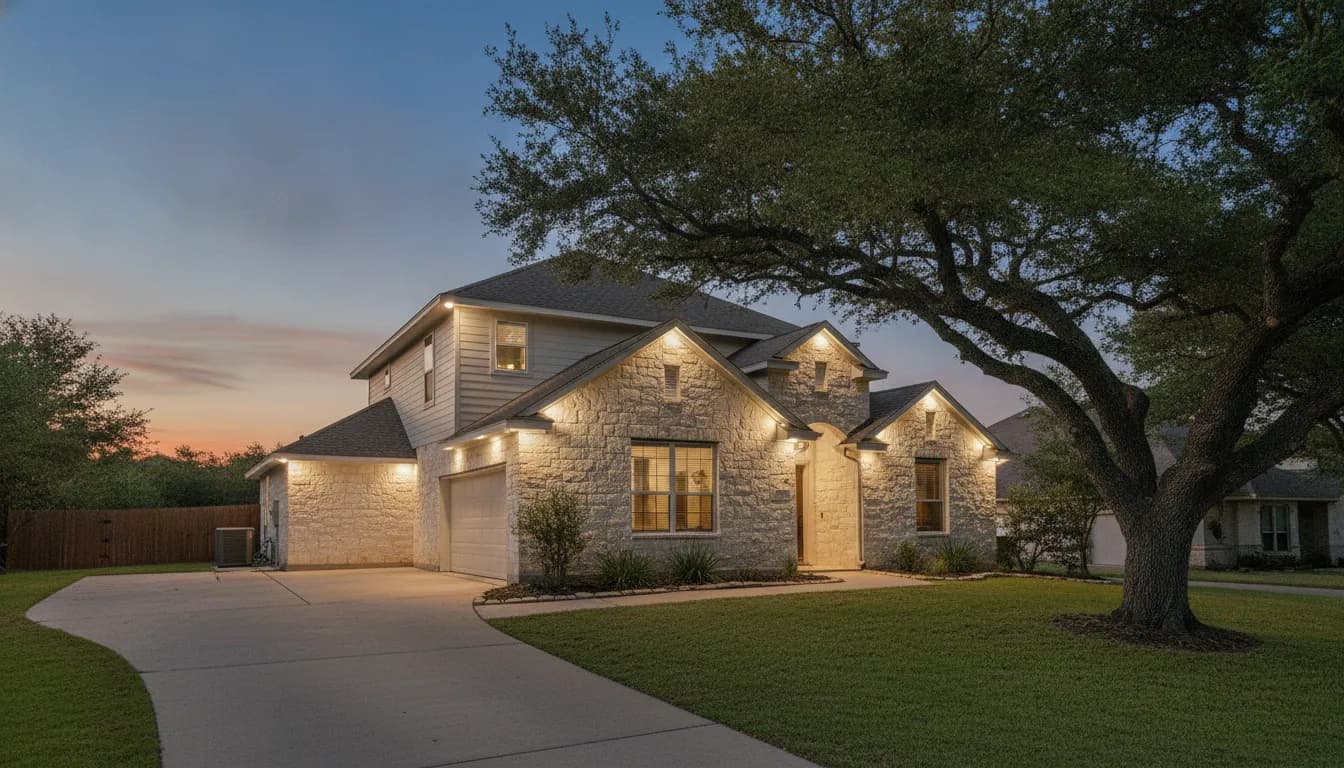
Choosing lighting for a Texas home starts with a practical distinction. A box of bulbs or string lights is not the same project as lighting an entire roofline. Homeowners in Austin, San Antonio, and Dallas may be comparing a do-it-yourself seasonal setup with a permanent system designed around the home's architecture.
Request a site-specific lighting quote
LED house lights can mean individual outdoor fixtures, decorative strings, or a professionally installed permanent roofline. The right choice depends on whether you want temporary lighting for a specific occasion or year-round illumination that stays in place for holidays, game days, security visibility, and everyday outdoor living.
Retail products can make sense for a small, flexible project. A permanent installation is judged by the elevations you want lit, the roofline's layout, and how much of the work you want handled. Sorting those categories first makes the rest of the comparison more useful. Product pages often use similar language for very different lights. The U.S. Department of Energy notes that residential LEDs generally use less energy and last longer than incandescent lighting. Those product-level benefits do not, by themselves, decide which setup fits your home.
What people mean by LED house lights
When someone searches for LED house lights, they may be looking for several different things. The phrase is broad enough to describe a replacement bulb, a fixture for one part of a home, or a complete lighting system that follows the home's exterior. Knowing which type you mean makes it easier to compare the right options and ask an installer the right questions.
The first category is indoor lighting. This includes replacement LED bulbs for existing lamps and ceiling fixtures designed for rooms such as kitchens, hallways, bedrooms, and living areas. In this context, the goal is usually to update the light source or replace an interior fixture without changing the home's exterior.
The second category is individual outdoor fixtures. A homeowner might use the term for a wall-mounted light, a floodlight, a wall pack, string lights, or landscape lighting. These products illuminate a specific location, such as an entry, walkway, driveway, patio, or side yard. Retail lighting collections commonly separate these fixture types because each one serves a different purpose and installation location.
The third category is exterior lighting designed to trace the house itself. These systems follow architectural features such as the soffit and roofline, creating an installed lighting outline rather than adding one standalone fixture. Because the placement follows the roofline, the design needs to account for the home's structure and the areas the homeowner wants to illuminate.
That third meaning is what LIT365 offers. LIT365 professionally installs permanent soffit and roofline lighting for homes and businesses in Austin, San Antonio, and Dallas. The hardware stays in place, so homeowners do not need to hang and remove temporary strings each season. One installed roofline can support different uses, including holidays, game days, security visibility, and patio or everyday outdoor living.
If you are looking for a professionally installed system rather than a box of bulbs or a single outdoor fixture, learn more about permanent roofline lighting and how it fits the architecture of your home.
Retail lights and an installed roofline solve different jobs
When homeowners search for LED house lights, they may be comparing very different products. A porch bulb, a patio string, and a roofline outline are not substitutes simply because each uses LEDs. Start by deciding what you want the lighting to do, where it belongs, and whether it should come down after a season or remain part of the home.
Retail listings often sell the fixture only. You choose the bulb, string, or fixture and then determine placement, power, mounting, and removal yourself. An installed system is planned around the house: placement follows the architecture of the roofline, and the goal is a coordinated outline rather than a collection of unrelated light sources.
| What you are buying. | Typical job. | Who handles placement. | What stays after the season. |
|---|---|---|---|
| LED bulbs or indoor fixtures | Lighting a room, porch, entry, or another defined point. | The homeowner or an electrician, depending on the fixture. | The bulb or fixture remains. Seasonal decorations are separate. |
| Plug-in or seasonal string lights | Adding temporary decoration to a patio, railing, tree, or facade. | The homeowner or a seasonal installer. | The strings are typically removed and stored after the season. |
| Individual outdoor wall or landscape fixtures | Illuminating a wall, path, planting area, or outdoor feature. | The homeowner, a landscaper, or an electrician. | The fixtures stay in their individual locations. |
| Professionally installed permanent roofline lighting | Outlining the architecture for holidays, game days, security, or everyday outdoor living. | A professional plans placement around the roofline and property. | The installed hardware stays in place instead of being hung and removed each season. |
The right choice depends on the job, not just the light source. Individual products can be appropriate when you need one fixture or a temporary accent. A permanent roofline system makes more sense when you want the home’s architecture outlined without repeating seasonal installation and removal. LIT365 plans permanent soffit and roofline lighting around the property rather than treating the house as a generic product surface.
For a deeper look at the available approaches, see this broader permanent outdoor lights guide. It covers lighting types in more depth; this section is intentionally focused on comparing the jobs each option solves.
Where permanent LED house lights fit on a Texas home
Homeowners in Austin, San Antonio, and Dallas can use permanent roofline lighting for several parts of life at home. The way the house is used does not have to change. LIT365 installs lighting along the soffit and roofline. The lights follow the architecture. They are not a seasonal decoration you take down later.
Holiday color
During the holidays, the roofline can become part of the home's seasonal display. Because the lighting stays installed, homeowners do not have to pull out temporary strings, climb to hang them, and repeat the process when the season ends. The result is a cleaner way to bring holiday color to the home while keeping the installation in place for the rest of the year.
Game day
Texas homeowners may also want lighting that fits game days or other occasions when friends and family gather. A roofline installation can be set for the moment, then changed when the occasion passes, without requiring a new installation each time. It gives the exterior a way to participate in the event while keeping the hardware in its planned location.
Everyday visibility and security
When there is no holiday or event, the same installed roofline can support everyday exterior visibility. Light along the home's architectural lines can make the property easier to see after dark and contribute to a more consistently lit exterior. This is an ongoing use, not a seasonal project homeowners have to remember to reinstall.
Patio and outdoor living ambiance
For patios and other outdoor living areas, roofline lighting can help create a more welcoming atmosphere for evenings outside. The goal is not to add a temporary string wherever it fits, but to use the home's existing lines as part of the overall setting. Homeowners can choose the setting that suits the moment and leave the installation ready for the next evening.
That flexibility is the practical difference between one permanent installation and repeatedly hanging and removing temporary strings. To see completed lighting projects, review the LIT365 gallery and consider how a roofline approach could fit your home's architecture.
What changes the plan from one house to the next
Two homes can ask for the same kind of roofline lighting and still need different plans. Start by looking at the roof shape and deciding how much of it should be visible after dark. A simple front elevation may call for a focused installation, while a property with several elevations may need lighting along the front, sides, rear, or selected architectural details. Placement follows the roofline, so the shape of the home matters more than a generic fixture count.
Access around the eaves is another practical factor. Roof height, landscaping, fences, driveways, and the space available for a crew to work can affect how the installation is approached. These details are easiest to evaluate from the service address rather than from a standard diagram. They also help clarify which roofline areas are realistic to include and which ones may need a different plan.
Your lighting goal changes the brief as well. Some homeowners want holiday color that can shift with the season, while others want a quieter everyday look for visibility around the home or outdoor living. Many want one installed roofline to support both. LIT365 permanently installs soffit and roofline lighting for those kinds of uses, so the conversation should identify when you expect the lights to be on and what you want them to do. If you want only holiday color or only an everyday appearance, say that at the start.
The property type matters too. A home and a commercial building can differ in scale, roof access, operating hours, and the elevations that need attention. LIT365 serves both homes and businesses, but the right scope begins with the building and its use, not a one-size-fits-all package.
LIT365 does not publish a citywide price or a per-foot rate. A quote starts with the service address and what you want to light. For an example of how two site-specific estimates can be compared, Austin readers can review the site-specific estimate comparison, without treating it as a universal price.
Before planning around a service area, check the service address in Austin, San Antonio, or Dallas. Exact radius and travel rules are confirmed from the address, not from a published mile radius. That address check keeps the project conversation tied to the actual property.
When a DIY kit and a professional install diverge
Retail "permanent" LED house lights and a professionally installed roofline can look similar in a product photo. The work is not the same. A kit is a box of track or strands, a controller, and instructions. You still decide where each run starts and stops, how it meets a peak or a valley, and how the cable gets from the eaves to power. A professional install starts from the house: which elevations you want lit, how the roofline actually turns, and how a crew can reach it.
DIY is a reasonable path when the run is short, the eaves are easy to reach from the ground or a stable ladder, and you are comfortable owning the mounting and the electrical connection. It is a weaker fit when the roof has several peaks, the sections you care about are on a second story, or you want the hardware quiet in daylight. Those are the houses where a product page cannot show the hard part.
Search results for LED house lights mix both offers on purpose. Some listings are DIY tracks you mount yourself. Others are installer brands that sell a finished roofline, not a carton. LIT365 is in the second group for homes and businesses in Austin, San Antonio, and Dallas. The company does not publish a kit, a wattage, or a controller spec, and this article will not borrow one from another brand to fill the gap.
What you still own if you install it yourself
A kit does not remove the seasonal decision. It only removes the yearly hanging if the hardware stays up and keeps working. You still own alignment, repairs if a section fails, and the question of whether the look matches the architecture or just follows whatever surface was easiest to clip to. If the goal is holiday color for one weekend, a temporary string may still be the smaller project. If the goal is a roofline you do not think about again until you want a different look, the install quality matters more than the box.
What to ask an installer that a product page will not answer
Ask which elevations are included. Ask how the hardware sits in the soffit during the day. Ask what the quote needs from you besides a photo. Then ask whether holiday color, game day, everyday visibility, and patio light are separate add-ons or settings on the same roofline. LIT365 treats those as uses of one system, not four purchases. If eave work and gutter work belong in the same visit, ask how gutters are handled. That part of the form routes to TX Gutter Solutions.
Skip questions a listing site invites but the live LIT365 pages do not answer: a ranked "best" kit, a lumen number, or a warranty term copied from another manufacturer. Those details vary by product, and repeating them here would pretend LIT365 sells that product. For a wider tour of permanent-light types, the permanent outdoor lights guide already exists. Use this section to decide whether you want a kit you mount or a roofline someone else plans.
What LED efficiency does and does not decide
LED is the technology inside most new house lights, whether you buy a bulb, a string, or a permanent exterior system. ENERGY STAR says LEDs produce light with up to 90 percent greater efficiency than incandescent bulbs. The same ENERGY STAR guide to LED lighting explains that a quality LED does not usually burn out the way an old bulb does. Its brightness fades over time, and lifetime is estimated from that fade.
Those figures are useful, and they are also easy to overread. They compare LED technology with older incandescent bulbs. They do not promise that a particular eaves kit, a box of holiday strings, or a professional installation will lower one house's electric bill by a set amount. Runtime, brightness, how many feet are lit, and how often the lights are on all change the result. LIT365 does not publish an operating-cost estimate, and this article will not invent one.
Efficiency also does not tell you which product fits the job. A porch fixture and a roofline outline are different uses, even when both are LED. You may want holiday color, a game day, or a quieter evening line along the house. The ENERGY STAR comparison does not rank those looks.
For a homeowner comparing LED house lights, the practical question is simpler than a savings calculator. Do you want hardware that stays on the house and can be used past one season, or do you want something you put up and take down? Energy use matters either way. It should not be the only reason you pick a permanent roofline over a string of bulbs, or the other way around.
How to read a listing before you buy LED house lights
A product grid is built to sell a unit. It is a poor brief for a house. Before you add anything to a cart, name the job in one sentence. Replacing the porch bulb, lighting the patio for one party, and outlining the front roofline for the year should not land in the same cart just because each result says LED.
Match the listing to a location on the house
Wall packs and floods are point lights. They belong at a door, a garage, or a yard, not as a stand-in for an eave. String lights belong on a railing, a tree, or a short run you are willing to take down. Landscape stakes belong in beds and along walks. A permanent roofline product belongs on the soffit, and only if you want that hardware to stay. If the listing never says where it mounts, it is not ready to compare with an installed system.
Separate the fixture from the install
Many outdoor LED listings sell the fixture only. The price on the page, if the retailer shows one, is not the cost of getting light onto your eaves. Mounting, lifts or ladders, and the time to make a crooked roofline look straight are outside that number. LIT365 does not publish a price against those listings, so do not treat a retailer total as a quote for this service. Austin homeowners who want to see which parts of a house move a site-specific estimate can read the Austin soffit lighting cost guide. It compares estimates. It does not print a citywide rate.
Ignore specs you cannot verify on your own house
Waterproof ratings, app features, and color counts are real product details, and they also change from one brand to the next. They do not tell you whether the front eave is reachable or whether you want holiday color and everyday light from the same run. Note them if you are buying a kit. Do not let them replace the address, the elevations, and the use when you are asking for an install.
Holiday-only shoppers have a separate decision. The guide to types of Christmas lights sorts seasonal styles, and the holiday light installation cost article covers hiring someone for a temporary display. Those are the right pages if the lights come down in January. They are the wrong pages if you want the roofline left alone.
When the listing and the house still do not match, stop shopping and describe the property. Completed lighting projects show the kind of outline an installed roofline produces, which is easier to judge than a thumbnail of a light strand.
Questions to settle before you request a quote
A useful lighting quote starts with the house, not with a product page. Before you ask LIT365 for a site-specific quote, write down the answers to these five questions. You do not need measurements. You do need a clear scope.
- Which elevations do you want lit? The front elevation is the usual starting point. A side yard, a rear patio, or a garage wing changes the length of roofline and how the crew reaches it.
- Is this for holidays, everyday use, or both? Permanent roofline lighting can be set for seasonal color, a game day, ordinary evening visibility, or a patio. Saying which of those matter keeps the plan from being a holiday-only string in disguise.
- If you stay with temporary lights, who hangs and removes them? That labor is the real comparison with a system that stays in place. If nobody in the house wants the ladder out twice a year, say so.
- Are gutters part of the same project? The quote form asks you to choose Lighting, Gutters, or Both. Gutter work is handled by sister brand TX Gutter Solutions through the same project brief. A lighting-only request should say lighting only.
- What is the service address? Austin, San Antonio, and Dallas each have a local phone line, but qualification uses the address. Do not assume a mile radius. The follow-up is about that property.
Bring those answers to the conversation. Skip product model numbers you found on a retail site unless you are asking how that product differs from an installed roofline. The point of the brief is the house and the use, not a brand shootout.
Frequently asked questions
Are LED house lights the same as permanent outdoor lights?
Not always. The phrase covers LED bulbs, indoor fixtures, individual outdoor wall and landscape lights, seasonal strings, and permanent roofline systems. Permanent outdoor lights are the version installed along the house and left in place. A bulb you screw into a porch socket is LED, but it is not a roofline.
Can one system handle holidays and ordinary nights?
That is the use LIT365 designs for. The same installed roofline can be set for holiday color, a game day, everyday exterior visibility, or a patio. You are not buying four separate installs. You are choosing which of those looks you want available on that house.
Do LED house lights cut my electric bill by a set percent?
No. ENERGY STAR says LEDs can produce light with up to 90 percent greater efficiency than incandescent bulbs. That is a technology comparison, not a promise about one home's bill or one exterior product. How long the lights run, and how much of the house is lit, changes the result.
Does LIT365 publish a price for LED house lights?
No. There is no citywide price and no published per-foot rate. A quote starts with the service address and the elevations you want lit. Austin readers who want to know how two site-specific estimates differ can read the Austin soffit lighting cost guide, which also does not list a flat price.
Which phone line should I use?
Use the line for the market where the property sits: Austin at 512-988-3110, San Antonio at 210-716-7750, or Dallas at 682-259-4438. You can also start with the quote form and include the service address. Neither path is a promise of an immediate callback.
Ask for a quote based on the house
If LED house lights, for you, means a roofline that stays up for holidays, game days, and ordinary evenings, the next step is the property itself. Tell LIT365 the service address and which elevations you want lit.
Request a site-specific lighting quote
Austin properties can also call 512-988-3110. San Antonio is 210-716-7750, and Dallas is 682-259-4438. If the project includes gutters, choose Both on the form so TX Gutter Solutions is part of the same brief.