
2026-10-20
Permanent Outdoor Lighting vs Christmas Lights: Which Fits Your Home?
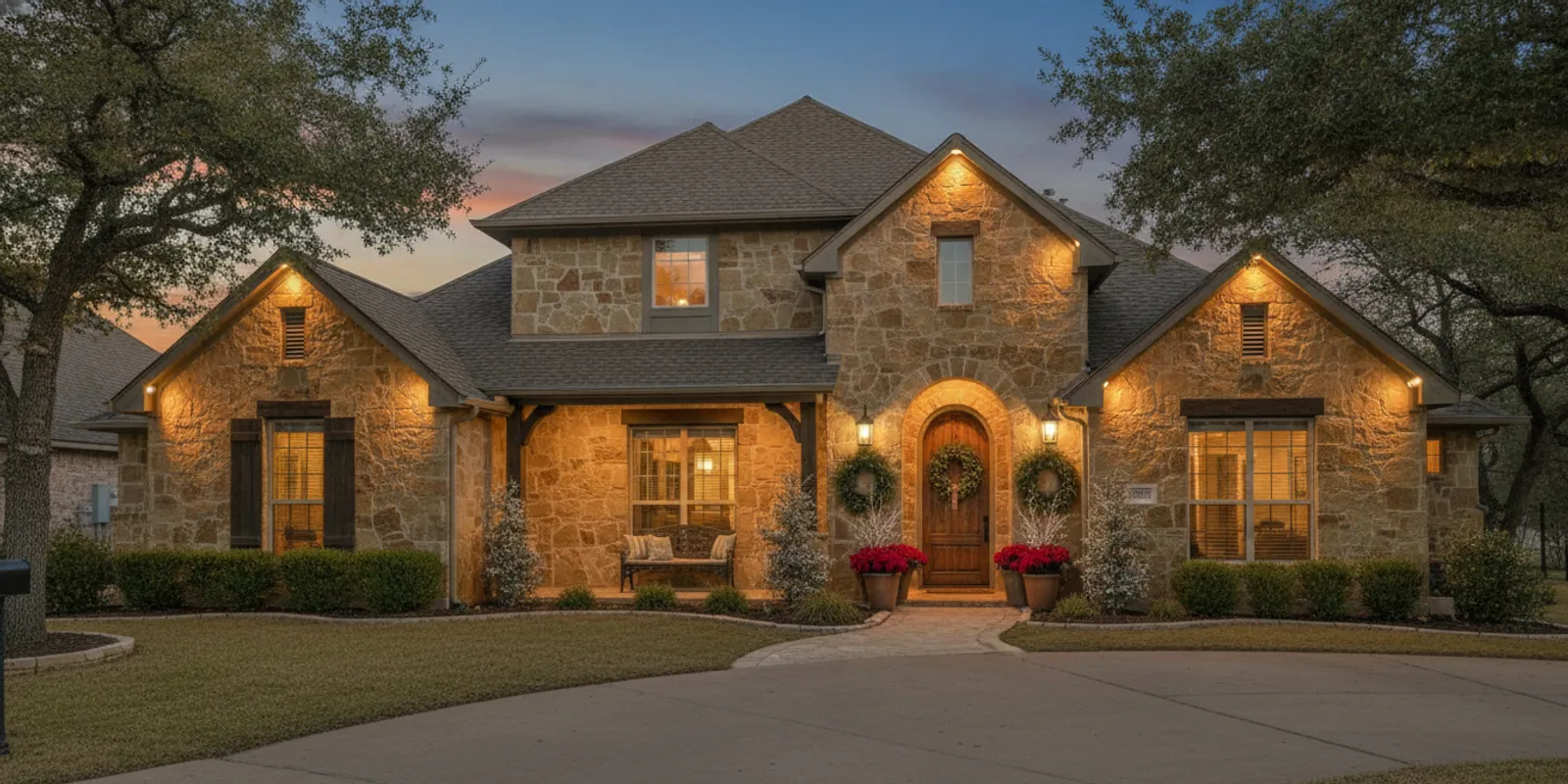
When weighing permanent outdoor lighting vs christmas lights, the main difference is not simply the time of year: it is whether you want a roofline system that stays installed and serves different occasions or a seasonal display that you put up for a particular holiday. Each can suit a different home, budget process, and decorating routine. The right choice depends on what you want illuminated, how often you want to change the look, and whether recurring setup is a burden.
Request a site-specific lighting quote
What is the difference between permanent outdoor lighting and Christmas lights?
Seasonal Christmas lights are generally put up for a holiday period and taken down afterward. They may be used along a roof edge, wrapped around trees, placed on railings, or arranged in other decorative patterns. The homeowner chooses the display and handles the setup, or arranges help for that season.
Permanent outdoor lighting is installed along a home's soffit or roofline and remains in place through the year. Rather than storing and rehanging the main roofline lights each season, the homeowner uses the installed system for different occasions and purposes. Holiday color is one possible use; game-day displays, security visibility, and patio ambiance are others. The exact options depend on the system and installation, so ask the installer to explain what the proposed setup can do instead of assuming every system has the same features.
In short, seasonal lights are a temporary display choice. A permanent roofline system is a year-round installation choice. Neither automatically replaces every other kind of outdoor decoration: a homeowner may still use seasonal ornaments, yard displays, or other lighting alongside a permanent roofline.
The distinction also affects what you are buying. A seasonal display can be selected and arranged anew each year, and the homeowner decides how much to put up. A permanent installation is a planned improvement to specific parts of the home's exterior. The installed roofline remains visible, whether the lights are being used for a celebration or not. That makes placement and the inactive daytime appearance part of the purchase decision, not a detail to consider only after installation.
It helps to avoid treating the two choices as interchangeable products. They can overlap in purpose, especially around the holidays, but they do not necessarily cover the same areas or offer the same flexibility. A permanent roofline can provide a consistent foundation for selected occasions. Temporary strings and decorations can extend beyond that foundation to trees, railings, windows, or yard features. Decide whether you are comparing two ways to accomplish one specific display or two different approaches to exterior lighting over time.
Which option fits the way you decorate?
Start with your habits, not with a product label. Think about how often you decorate, which parts of the property matter, and whether you want lighting outside the holiday season. These questions help clarify whether your priority is a single seasonal look or a roofline that can serve several purposes throughout the year.
- Choose seasonal lights as the main approach if you enjoy planning a fresh holiday display, want to decorate several areas beyond the roofline, or prefer to decide each year whether to put up lights.
- Explore permanent roofline lighting if you want the roofline lit for more than one occasion and would rather not make hanging and removing roofline lights a recurring seasonal task.
- Consider using both if you want a consistent roofline foundation but also enjoy adding temporary lights, yard decorations, or a distinctive holiday feature.
These are practical starting points, not rigid rules. A homeowner who loves elaborate seasonal decorating may still value permanent roofline lighting for other occasions. Someone who prefers a simple holiday display may find that temporary lights are enough. The useful question is which work you want the lighting to do and how much of the property it needs to cover.
Try describing your preferred outcome in plain terms before comparing estimates or product descriptions. For example: “I want the front roofline to look finished for the holidays, but I do not want to climb a ladder each year,” or “I enjoy changing the whole display and want to include the trees and front walk.” The first statement points toward discussing a permanent roofline. The second makes the freedom of a seasonal display especially important. A third possibility might be: “I want the roofline available for several occasions, but I still want to add a wreath and a few yard decorations in December.” That describes a mixed plan.
Then review your recent seasons honestly. Did you put up the display you intended, or did access, time, storage, or setup effort cause you to scale it back? Did you wish you could change the layout more often? Do you use exterior lighting outside the holiday period, or would you like to? These observations are more useful than assuming that one option is automatically more convenient or better value for every household.
Household routines matter, too. One person may enjoy a planned decorating weekend and have a safe, manageable way to reach the areas involved. Another may find the same routine difficult or may prefer to spend that time on other tasks. A family may have changing schedules, while a property owner may care most about a consistent appearance from the street. Write down the actual friction points. “I dislike storing boxes” and “I want a different look every year” are different needs, and they can lead to different decisions.
How does the installation routine compare?
With seasonal lights, the work repeats whenever you want a display. That can mean planning the layout, getting the lights and accessories out of storage, reaching the areas to be decorated, arranging the display, checking it, and later taking it down and putting it away. The amount of work varies with the home's shape, the display, access, and whether someone else handles installation.
Permanent lighting changes that routine. A professional installer plans and installs the roofline system once for the selected areas; the hardware stays in place. This avoids rehanging and removing the primary installed roofline lights each holiday season. It does not mean there is no planning or future attention: the property owner should understand how the system is operated, what care the installer recommends, and whom to contact if an issue comes up. Ask for those details during the proposal process rather than presuming them.
Access is worth considering before deciding. A tall or complicated roofline can make repeated seasonal work inconvenient. But a difficult-to-reach edge also matters when planning a permanent installation: an installer needs to assess the actual property and proposed elevations. Do not assume a quote based on a photograph or a generic per-foot estimate captures every access or layout condition.
For a fair comparison, consider the routine over several seasons. List what you currently do, what you pay someone else to do if applicable, and which tasks you would still want to do even with a permanent roofline system. This is not a promise that a permanent system will be less costly over time; it is a way to compare the work and value you personally care about without relying on a made-up payback calculation.
Break the seasonal routine into stages to see where the burden really sits. First, there is preparation: finding the lights, checking what you already own, and deciding whether the old layout still works. Next comes installation, which may involve arranging access to the roofline and securing lights where you want them. Later, you may need to inspect the display and address any sections that do not look as intended. Finally, removal and storage take time. If you hire help for only some of these stages, record which ones. The details can help you compare a realistic annual routine with the ongoing responsibilities of a permanent installation.
Do not assume a permanent setup means that no future decisions or tasks are needed. The system remains in place, but you still need to know how its specific operation works and what the installer recommends for care. You may also want to decide when to use it, which display suits a given occasion, and how it fits with other exterior lights. The difference is not “work” versus “no work”; it is recurring seasonal installation and removal versus a one-time installation followed by operation and care questions that should be explained for the specific system.
If a household currently hires someone to hang seasonal lights, compare the service being purchased with the permanent project scope. Is the seasonal help for the roofline alone, or does it include trees, gutters, or other areas? Does the help include removal? Are you comparing one season of labor with an installed system that covers only the roofline? Make the boundaries explicit. Otherwise, the comparison can overstate the convenience of one option or overlook what the other actually provides.
Some readers will want to keep the seasonal ritual even if they choose permanent roofline lighting. They may enjoy selecting ornaments, adding a temporary feature near the entry, or arranging a display in the yard. That is a valid outcome. A permanent system does not require you to stop decorating; it changes the recurring work for the areas it covers. The useful question is which part of the routine you want to simplify and which parts you want to keep.
What will each option look like on the house?
Seasonal lights can be arranged in many ways. They can outline a roof, emphasize a porch, wrap a tree, or form a larger holiday display. This flexibility is useful if you want to change the decoration substantially from one year to the next. The finished appearance depends on the lights, placement, spacing, the home's architecture, and the care taken during installation.
Permanent soffit lighting follows the roofline and stays installed when it is not being used for a holiday display. Its appearance while inactive is therefore part of the decision. Look at the relevant elevations in daylight as well as at night, and ask how the proposed placement will relate to soffits, trim, corners, and the overall architecture. The goal is not just to ask whether a system can light the home; it is to understand what will be visible on the home throughout the year.
Before approving a plan, identify the elevations you want included. For example, do you want the front roofline only, or do side and rear elevations matter too? Is there a patio or another zone you want to discuss? A home's front view is not the same as a complete lighting scope. Be clear about which areas matter most so the proposal reflects your priorities.
It can help to review an installer's project gallery for examples of roofline placement and finished homes. Treat examples as a way to discuss design, not as a guarantee that your house will look identical: roof shapes, colors, trim, and the included elevations vary. See the LIT365 permanent lighting installation gallery for examples to use as a starting point for questions.
Evaluate the appearance from more than one viewpoint. The front elevation may be the most important view from the street, but the side of the home can be visible from a neighboring property, a driveway, or a shared approach. The back may matter more if you spend evenings on a patio. If you care about a particular view, name it when describing the project. A proposal limited to the front roofline will not automatically address what you see from the backyard.
For seasonal lights, the visual plan can be redesigned each year, though the display still depends on the available lights, attachment options, and the home's layout. That flexibility is valuable for people who enjoy experimenting. The tradeoff is that a new plan can also mean new setup choices. Permanent lighting starts from a more consistent roofline layout; the precise effects available depend on the installed system. Ask how the proposed system will look during the occasions you care about and what changes it supports, rather than relying on a generic product description.
Make a simple viewing checklist before you meet with an installer. Note where you stand when you judge the home: the street, the front walk, the driveway, or a patio. Identify roof corners and transitions that you think are visually important. Consider whether you want only a visible front outline or a more complete treatment around the building. This is not a technical design exercise. It is a practical way to communicate what “finished” means to you and to avoid approving a scope based on an assumption that was never discussed.
Also consider how seasonal decorations and permanent fixtures might coexist. If you plan to keep a wreath, entry accents, or yard pieces, explain that preference. You can ask whether the proposed roofline scope is meant to be the central display or simply one layer of it. Do not infer that adding permanent lights makes all other decorations redundant; the answer depends on the look you want and the areas each element covers.
Can permanent roofline lighting be used beyond Christmas?
Yes. The purpose of a permanent roofline system is not limited to a December display. A homeowner may use the installed lighting for holidays, game days, security visibility, or patio ambiance. That range can make a year-round installation relevant to someone who wants more than one seasonal use from the roofline.
Still, describe how you want to use the system through the year. You may want a subtle look on ordinary evenings, a more noticeable display for a celebration, or lighting associated with a particular event. Ask the installer to explain which effects the proposed system supports, how changes are made, and whether the relevant areas are included. Product details and controls are not interchangeable across installations, so confirm capabilities rather than assuming a particular app, color selection, schedule, brightness, or operating feature.
Also separate the goal from the location. Roofline lighting may contribute to the home's exterior appearance, but it is not automatically a replacement for every other lighting need. A path, entry, driveway, landscape, or work area may call for a different type or placement of light. If you have one of these goals, say so; do not assume a roofline proposal includes it.
Think through a simple calendar to test whether year-round use is meaningful for you. You might list a regular weeknight, a holiday, a game day, a family gathering, and an evening spent outdoors. For each one, describe what you want the light to accomplish. If the roofline would serve only one short period, the added use may not matter much to your choice. If you have several distinct occasions in mind, ask whether the specific proposed system can support them and whether the areas you care about are included.
Be precise about phrases such as “security lighting.” The customer may want more visibility around the home, but a roofline system should not be presumed to illuminate every entry, pathway, or dark corner. Describe the locations and outcomes you have in mind. Ask the installer to clarify what the planned roofline can contribute and whether another lighting approach is needed for a different area. This keeps the conversation tied to the actual property rather than to a broad label.
Patio ambiance is another goal that benefits from a location-specific discussion. If you spend time on a rear patio, a front-only roofline plan may not address that space. Explain where the patio sits relative to the home and which views you want to change. The purpose is not to assume that a roofline system automatically includes patio fixtures; it is to make sure that the intended use is part of the scope conversation.
For game days or other events, consider whether you want a brief celebratory look or a general year-round effect. You do not need to settle on every occasion before requesting a quote, but it helps to name the occasions that matter most. A provider can then discuss the capabilities of the proposed system in context. Ask for a clear explanation rather than inferring features from a demonstration, a photo, or a description of another installation.
How should you compare the cost of the two choices?
There is no reliable universal price comparison between a seasonal display and permanent lighting. A seasonal project can be small or extensive, self-installed or professionally installed, and repeated on a schedule chosen by the homeowner. A permanent installation is quoted for a particular property and scope. Comparing one season's display with a permanent system without accounting for the work included in each can lead to a misleading conclusion.
For a seasonal plan, write down what you actually spend and do: the lights and supplies you buy, any installation or removal help you arrange, the areas you decorate, and how often you replace or change the display. Do not assume every household has the same recurring expense. Some homeowners reuse what they own and do their own work; others hire help or change the display regularly.
For a permanent system, ask for a quote based on the property address and the elevations you want lit. Scope and site access matter. A proposal should make clear what portions of the home are included and what the quoted work covers. Lit-365 does not publish a citywide price or a per-foot rate; a quote is site-specific. That is a reason to provide the real project details, not to rely on an invented average.
When you compare options, consider more than the initial number. Ask yourself whether avoiding seasonal roofline setup matters, whether you will use the system beyond Christmas, and whether you want control over a different display each year. Those are personal value questions rather than universal savings claims. Avoid treating a hypothetical number of years or a generic payback estimate as proof that either option costs less for your home.
A useful comparison starts with a defined scope on both sides. For the seasonal option, describe what you would actually put up: roofline only, front entry, trees, yard, or several areas. Say whether you would install it yourself or hire someone and whether removal is part of the arrangement. For the permanent option, identify the elevations and any other zones you want discussed. If the permanent proposal covers a roofline while the seasonal plan covers the whole front yard, the two totals are not a direct comparison. First decide whether you want to compare the roofline portion alone or the complete display experience.
You can make a personal worksheet without predicting a long-term return. Use one column for the seasonal routine and another for a permanent installation. In the seasonal column, list your current lights and supplies, any help you hire, the tasks you repeat, and the areas covered. In the permanent column, list the written project scope, the installed areas, the operation and care information provided, and the recurring tasks that would remain. Add a final row for nonfinancial preferences, such as enjoying a new layout each year or avoiding repeated roof access. This keeps the comparison grounded in your own circumstances.
Do not treat every inconvenience as a dollar amount unless you have a clear basis for doing so. Time, effort, storage space, and access can matter even when they do not appear on a quote. You can record those considerations honestly without claiming that they prove a specific savings figure. The decision may be worthwhile for convenience, appearance, or use across multiple occasions, even if a simple calculation cannot show that it costs less over a particular period.
Likewise, do not assume that a permanent installation will have the same cost for every home. A straightforward roofline and a more complex property are different projects. Selected elevations, access, and requested scope affect what needs to be planned. The company does not publish a citywide price; the accurate next step is to request a quote using the actual address and desired areas, then read what the proposal includes. This avoids both unsupported averages and disappointment caused by an estimate that does not match the property.
What should a permanent lighting quote explain?
Two proposals are only comparable when you understand what each one includes. Read the scope carefully and use the same questions with each provider. If an item is not clear, ask for clarification before deciding.
- Property and elevations: Confirm the service address and list each roofline or other area included. Check whether the plan covers only the front, or additional sides as well.
- Placement: Ask where the lighting will sit in relation to the soffit and roofline, and how the plan addresses corners or changes in roof shape.
- Installation scope: Confirm what work the proposal includes and whether any site conditions or access needs still need to be evaluated.
- How the system is used: Ask how to operate it and what holiday, game-day, security-visibility, or patio uses are supported by the specific proposal.
- Included materials and details: Have the provider identify the proposed components and explain any terms you do not recognize. Do not compare assumptions about features that are not written down.
- Care and support: Ask what maintenance or care is expected and how to raise questions after installation. Do not infer a warranty or service commitment that the proposal does not state.
- Total scope and exclusions: Find out whether the quote excludes elevations, controls, or other work you assumed would be included.
Use the same property details and desired elevations when seeking multiple estimates. Otherwise, a lower quote may simply cover less of the home or a different installation plan. Ask each provider to clarify any differences in scope so you are comparing like with like, not just the totals at the bottom of separate proposals.
One practical way to review a proposal is to read it in three passes. First, check the address and areas: does it describe the property you asked about, and does it name the roofline sections you want? Second, check the design and use: can you tell where the lights will be placed and what the proposed system is intended to do? Third, check the boundaries: what is excluded, still undecided, or dependent on site evaluation? Write down any unanswered item and ask for a response before treating the estimate as final.
Ask for ambiguous terms to be explained in ordinary language. A label in a proposal may not tell you whether a particular elevation is included or how an intended use will work. The goal is not to demand a specific feature that the provider has not offered; it is to understand what you would receive. If a desired capability matters to your decision, ask whether it is part of this proposal and request the answer in a form you can refer back to.
Pay attention to assumptions about the home's exterior. A photograph may show only one angle, and a short description may not capture roof transitions or access. Share the full service address and explain the elevations you have in mind. If the proposal still depends on a site assessment or other confirmation, note that distinction. A preliminary discussion is useful, but it is not the same as a property-specific scope that resolves every open question.
When reviewing two proposals, make a side-by-side list rather than relying on memory. Include the address, front/side/rear areas, any patio-related discussion, placement information, operating explanation, and care or support details. Mark each line “included,” “not included,” or “unclear.” That simple process shows whether one estimate is lower because it covers less or because the plans genuinely differ in another way. Resolve unclear items before choosing.
Finally, match the proposal to your original goal. If the reason you are considering permanent lights is to stop repeating roofline setup, verify that the included scope covers the roofline where that routine currently occurs. If you want several occasions supported, verify that the provider has addressed each intended use. If you mainly want a seasonal display across trees and yard features, ask whether those areas are within the permanent proposal or remain part of your seasonal plan. The quote is useful only when it answers the question you are actually trying to solve.
What information should you prepare before choosing?
A short project brief makes it easier to discuss the right solution. You do not need to have every design decision settled. Start with the home's address, the areas you want lit, and the jobs you want the lighting to perform.
- Set your main goal. Decide whether the priority is a Christmas display, less recurring roofline setup, lighting for multiple occasions, or a combination.
- Mark the elevations. Note which sides of the home matter. If you are unsure, describe what you want to see from the street, yard, or patio.
- Describe your current routine. Say how you handle seasonal lights now and which parts of the task you would like to avoid or keep.
- List the occasions you care about. Include ordinary evenings, holidays, game days, or patio use, and ask what the proposed system can support.
- Ask for a property-specific plan. Share the service address and confirm that access, roof shape, and the selected elevations are reflected in the quote.
- Review the appearance year-round. Consider how the installed hardware will look when it is not being used for a holiday display.
These details help a provider understand your intent without assuming that every home needs the same layout. If you are still weighing the broader benefits and limitations of a year-round system, read the guide to permanent outdoor lights as another starting point for your decision.
Before sending the brief, make it concrete but concise. A useful note might say: “The address is in Austin. I am considering the front roofline and possibly the side visible from the driveway. We currently put seasonal lights on the front roof edge, and I want to avoid repeating that setup. I would also like to understand whether the roofline could be used for a few occasions beyond December.” That communicates location, scope, current routine, and desired uses without prescribing a technical solution.
If your first priority is a special seasonal look, provide a different kind of brief. You might explain which parts of the display matter most, which areas you want to decorate temporarily, and how much change you want from year to year. This can reveal that a permanent roofline should be a smaller part of the plan, or that seasonal decorating already gives you the flexibility you want. The exercise is useful even if you ultimately decide not to request a permanent installation.
It can also help to separate “must have” from “nice to have.” A must-have may be the front roofline or avoiding repeated work at a hard-to-reach section. A nice-to-have might be lighting another elevation if the scope and site plan allow it. Keep the list short enough that a provider can understand your priorities. If everything is equally important, it is harder to make a clear choice when the actual proposal is in front of you.
For properties in a homeowners association or with shared views, consider whether you need to review any applicable community guidance before deciding. Do not assume that a particular display or fixture is permitted or prohibited; check the relevant rules for your own property. If the property has a special access or ownership arrangement, mention it early so the quote discussion can account for the right circumstances.
Which choice works better for common situations?
You enjoy changing the holiday display every year
Seasonal lights may be the better fit if changing the arrangement is a central part of the fun. You can choose a new look, decorate areas that a roofline system would not cover, or skip a year if you wish. Permanent roofline lighting could still be useful for occasions beyond the holidays, but it does not remove the appeal of a separate seasonal display if variety is your priority.
For example, a household that likes to use different colors, add yard pieces, and move the emphasis from the porch to the trees may value the freedom to rework the display. The key question is whether the recurring setup is an acceptable part of that enjoyment. If it is, seasonal lights remain a reasonable choice. If the roofline work is the part you do not want to repeat, you could consider a mixed approach: keep the changing decorations and discuss a permanent roofline as a separate foundation.
You want lights for several occasions
A permanent system is worth exploring if you want the roofline to serve holidays, game days, or patio ambiance without rehanging the main lights for each occasion. Confirm that the proposed system supports the looks you have in mind. Do not base the decision on a feature you have not discussed or seen in the proposal.
Make a short list of the occasions, then rank them. If holiday use is the main priority and other uses are occasional, state that. If regular evenings or a patio matter more than a seasonal display, say so. The installer can explain how the plan relates to those goals, and you can decide whether the installed roofline is the right scope. A list also helps avoid paying attention to hypothetical uses that you do not expect to choose.
You find roof access or seasonal setup inconvenient
Reducing recurring roofline setup may be an important benefit if the annual routine is difficult or unwelcome. A permanent installation still requires a careful site-specific plan, especially where the home has complex rooflines or challenging access. Ask the installer how those conditions affect the proposed scope rather than assuming that permanent means suitable for every location without assessment.
Separate the task you want to avoid from the parts you are comfortable doing. Perhaps you are happy to place decorations at ground level but do not want to reach the upper roofline. That suggests comparing a permanent roofline with a seasonal plan for the remaining areas, not necessarily replacing the entire display. Explain the difference when requesting a quote, so the proposal can address the difficult part of the routine rather than a broader project you may not need.
You only want a small holiday accent
If your goal is limited to a short seasonal display, temporary lights may be a straightforward choice. A larger permanent installation could be more than you need. Compare the scope you would actually use with the work and commitment involved in each option, rather than choosing a permanent system just because it remains in place.
A modest display might involve a small area near the entry or a limited roofline. Consider whether the existing seasonal approach already meets that need and whether you want the same appearance for other occasions. If not, there may be little reason to expand the project. The right answer can be to keep a simple seasonal routine, especially when you enjoy it and the setup is manageable.
You want both convenience and a custom holiday look
It may be possible to combine a permanent roofline with seasonal decorations elsewhere. Think of the installed system as one element of the home's exterior lighting, not automatically the entire holiday plan. Decide which areas the permanent system should cover and which decorations you still want to add temporarily.
For instance, you might want a consistent roofline for several occasions but still enjoy decorating a porch or yard. List the two roles separately: the permanent system handles the roofline purpose you have identified; temporary decorations create the distinctive seasonal details. This approach can preserve flexibility while reducing some recurring roofline work. It is still important to define the permanent scope carefully and avoid assuming that it includes locations beyond the ones named in the proposal.
You are moving into a home or planning exterior updates
A move or exterior project can be a natural time to think about roofline lighting because you are already reviewing how the home looks and how you plan to use its outdoor areas. That does not mean you need to decide immediately. First learn the property's layout, note which sides are visible or used, and observe how your household spends time outdoors. You may find that the front roofline is the only area you care about, or that a rear patio shapes the decision more than the street view.
If other exterior work is underway, keep the lighting discussion specific and coordinated. Identify which work is already planned and ask how a proposed lighting installation fits the selected elevations. Avoid assuming that a separate project automatically includes preparation or changes to the lighting scope. Clear timing and written scope reduce confusion about which work is being considered.
What mistakes can make the comparison less useful?
- Comparing different scopes. A roofline-only installation and a multi-area seasonal display do not do the same job. Write down the areas included in each option.
- Looking only at December. If you want game-day or patio use, include those goals in the comparison. If you only want Christmas lights, do not assign value to uses you do not expect to make.
- Assuming every permanent system has the same features. Ask for the specific operating details and capabilities of the proposed system.
- Forgetting how the installation looks when inactive. Permanent hardware remains on the home throughout the year. Review placement and visibility in daylight as well as at night.
- Relying on a citywide price or generic payback claim. Property scope and access affect the proposal. Use a quote for your address instead of an invented average.
- Assuming permanent lighting replaces every other light. A roofline plan may not address paths, entries, landscapes, or work areas. Name those needs separately.
- Deciding before the elevations are clear. A proposal for one side of a home is not directly comparable with a proposal covering several sides.
Another mistake is treating the word “permanent” as a guarantee that a system will suit every home or every use. The installation stays in place, but its fit depends on the property, proposed placement, operating details, and your expectations. Ask concrete questions about the exact plan. If you cannot explain what is included after reading the proposal, pause and ask for clarification.
It is also easy to compare an ideal seasonal display with a narrowly scoped permanent quote, or vice versa. A homeowner may imagine a full seasonal display covering the roof, porch, and yard, then compare it with a roofline-only permanent project. That does not answer whether one is better; it compares different outcomes. Use the same priority areas for both options, or explicitly acknowledge that each one is meant to do a different job.
Do not let a single dramatic example stand in for your own needs. A photo of a large home with multiple elevations may be inspiring, but it cannot tell you what your property requires or what a quote includes. Use examples to identify the look or placement you want to discuss, then ask how your actual home differs. The gallery can prompt useful questions, but your own scope still needs to be clear.
Finally, do not decide solely from an assumed resale benefit, energy claim, or fixed payback period. This comparison is about the work, appearance, scope, and uses you can evaluate directly. If you care about another factor, ask for information tied to the specific system and property instead of relying on a broad claim that may not apply to your situation.
Frequently asked questions
Are permanent outdoor lights the same as Christmas lights?
No. Seasonal Christmas lights are typically put up for a holiday display and removed afterward. Permanent outdoor lighting is installed on the home, often along the soffit or roofline, and stays in place for use on different occasions. Ask about the specific features of any system you are considering.
Can permanent roofline lights still be used for Christmas?
Yes. Holiday color can be one use of a permanent roofline system. The same installed system may also be used for game days, security visibility, and patio ambiance, depending on the installation and its capabilities. Confirm how the proposed system handles the looks and uses you want.
Do permanent lights mean I can never use temporary decorations?
No. A permanent roofline system does not prevent you from adding seasonal decorations elsewhere. Some homeowners may use both approaches, with the permanent system covering the roofline and temporary decor adding other holiday details.
Is permanent lighting cheaper than buying Christmas lights every year?
There is no single answer that applies to every home. The comparison depends on the permanent installation's site-specific scope and on what you currently spend, reuse, install, or hire out for seasonal displays. Compare your actual routine and a written quote; do not rely on a generic price or payback estimate.
How do I get a quote for my home?
Prepare the property address, the elevations you want lit, and a short description of how you plan to use the lights. A site-specific quote can then address the property and selected scope. LIT365 serves Austin, San Antonio, and Dallas, with address qualification before a quote.
Share your address and request a quote
Choose seasonal Christmas lights if the changing display is the point; consider permanent roofline lighting if you want an installed system for more than one occasion and less recurring roofline setup. Define the areas and uses that matter, then compare proposals that spell out the same scope.