
2026-09-07
Commercial Lighting: Types, Benefits, and Buying Tips
Your business deserves exterior lighting that works as hard as you do. Commercial lighting can make a storefront easier to find, improve visibility around entrances, and create a polished appearance for customers, employees, and visitors. It can also support seasonal displays, promotions, community events, and everyday curb appeal. Permanent outdoor LED systems give businesses a flexible alternative to temporary holiday lights, with programmable colors, patterns, brightness levels, and schedules. Whether you manage a retail store, restaurant, office, HOA, or commercial property, the right lighting plan should balance appearance, safety, energy use, and maintenance. Here is what to consider before choosing fixtures or hiring an installer.
Key Takeaways
- Match fixtures to each space: Consider the property’s purpose, ceiling height, activity, brightness needs, glare control, and weather exposure before choosing commercial lighting.
- Evaluate the full investment: Compare energy use, maintenance, controls, installation, warranties, replacement parts, and service support instead of focusing only on the initial price.
- Simplify year-round exterior displays: Lit 365’s permanent outdoor LED systems provide programmable colors, patterns, and schedules for daily curb appeal, holidays, promotions, and special events.
What Is Commercial Lighting?
Commercial lighting includes the fixtures, controls, and systems used to illuminate business properties and public spaces. It can support warehouses, offices, retail stores, restaurants, schools, parking lots, storefronts, and building exteriors.
A commercial lighting plan considers more than where to place fixtures. It accounts for how people use the space, how much light different tasks require, how long the lights operate, and how the property should look after dark. Solutions may include high-output industrial fixtures, efficient interior LEDs, security lighting, or low-profile outdoor LEDs for architectural accents and seasonal displays.
Compare commercial and residential lighting
Residential lighting typically focuses on comfort, decoration, and everyday household tasks. Common examples include table lamps, kitchen pendants, bathroom fixtures, recessed lights, and porch lights. Commercial lighting must often support larger spaces, longer operating hours, heavier use, and specific safety requirements.
A warehouse may need high bays and consistent illumination across aisles, while an office may use troffers or flat panels to reduce glare at workstations. A retail store may combine general lighting with track or accent fixtures to draw attention to products. Outdoor areas may require wall packs, floodlights, parking lot fixtures, or pathway lighting. Commercial lighting solutions include specialized fixtures for these varied environments.
Commercial properties also need durable equipment and reliable controls. Outdoor fixtures should have appropriate ratings for moisture, temperature changes, and other weather conditions. Professional planning and installation can help ensure the system meets local electrical requirements and performs reliably over time.
Use lighting for safety, function, branding, and curb appeal
Effective commercial lighting helps employees, customers, and visitors see clearly as they work, shop, walk, park, or enter a building. In warehouses and industrial facilities, poor visibility can contribute to accidents, inventory errors, and slower operations. The impact of efficient warehouse lighting shows why brightness, even distribution, and glare control matter as much as fixture appearance.
Lighting also shapes how people experience a business. A well-lit entrance can feel more welcoming, while illuminated signs, landscaping, and architectural details can reinforce a company’s visual identity. Permanent outdoor LED systems give businesses one professionally installed solution for everyday curb appeal, holiday displays, promotional events, and seasonal celebrations.
With programmable colors, patterns, dimming, and schedules, a business can change its exterior lighting without installing and removing temporary lights each year. Smart controls can also automate operation and reduce unnecessary energy use. LED lighting controls help businesses adjust lighting to occupancy, schedules, and changing conditions.
Which Commercial Lighting Fixtures Are Available?
Commercial lighting fixtures are designed for more than basic illumination. The right fixture can help employees complete detailed tasks, guide customers through a property, highlight products, improve visibility around entrances, and create a polished exterior appearance. Your best option depends on the space, ceiling height, mounting surface, activity, and lighting goals.
Start by identifying how the area is used. A warehouse may need powerful, evenly distributed light from a tall ceiling, while a retail store may need adjustable fixtures that draw attention to merchandise. An office may benefit from low-glare ceiling panels, and a storefront may need durable exterior fixtures for entrances, signs, and parking areas.
When comparing products, review lumen output, color temperature, beam angle, energy use, controls, mounting method, and service requirements. Outdoor fixtures should also have an appropriate wet-location rating and durable housing that can withstand rain, snow, dust, and temperature changes. Commercial lighting solutions include options for industrial, office, retail, and outdoor applications.
A lighting professional can assess the layout and recommend fixture locations, spacing, and light distribution. This helps prevent common problems such as glare, uneven coverage, excessive brightness, and dark areas near walkways or building entrances.
Use high bays, low bays, and linear high bays
High bay fixtures are made for buildings with tall ceilings, including warehouses, distribution centers, manufacturing facilities, and aircraft hangars. Their strong output and broad distribution illuminate large floor areas from a significant mounting height, helping workers see inventory, equipment, loading zones, and walkways.
Low bay fixtures are better suited to spaces with shorter ceilings, such as workshops, service areas, and smaller commercial buildings. Using a fixture designed for a taller ceiling in a low space can create glare and unnecessary energy use.
Linear high bays have a long, narrow profile that works well above aisles, shelving rows, production lines, and workstations. Their shape supports even illumination and a tidy ceiling layout. Compare high bay, low bay, and linear lighting based on mounting height, coverage, lumen output, and the work performed below.
Choose troffers, flat panels, and recessed fixtures
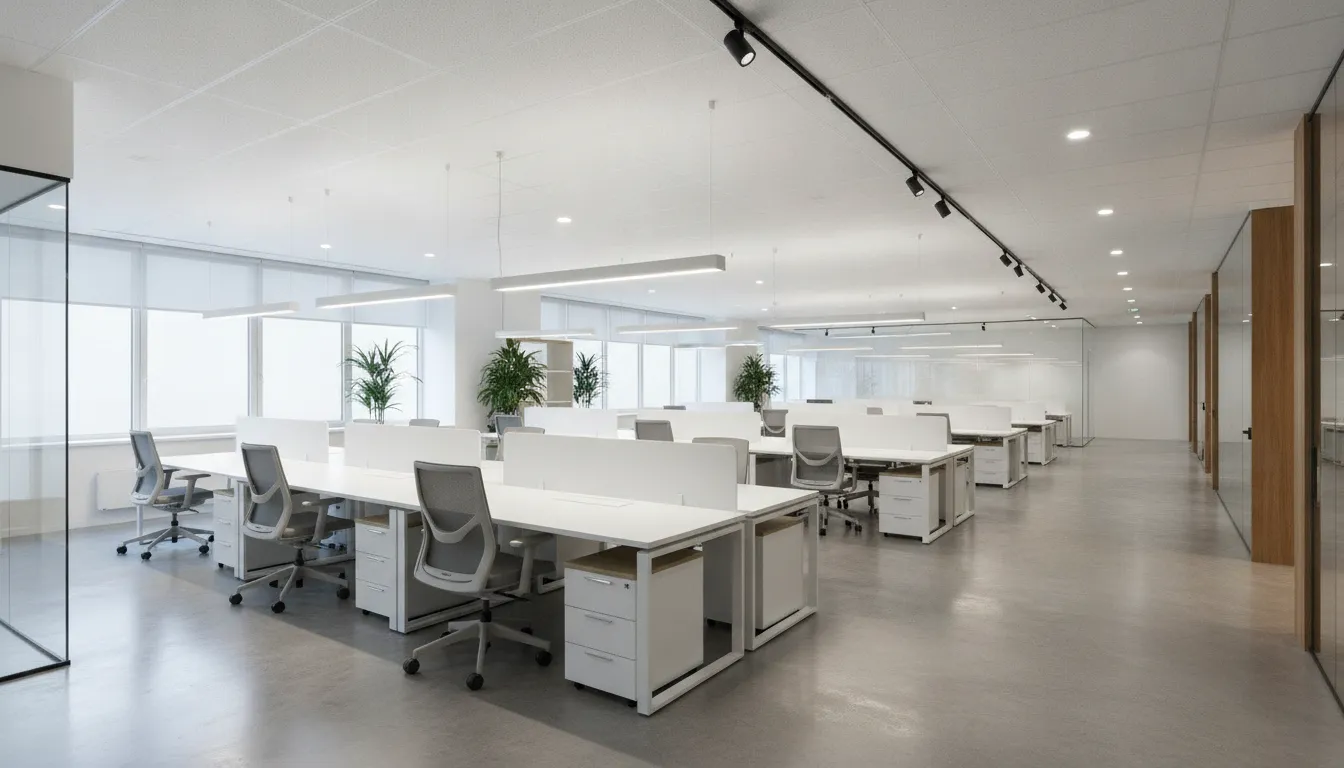
Troffers are rectangular fixtures designed to fit into suspended grid ceilings. They are common in offices, schools, medical facilities, hallways, and commercial interiors. LED troffers can provide consistent illumination while reducing the maintenance associated with older fluorescent systems.
Flat panels offer a slim, modern profile for offices, retail spaces, corridors, and other areas where a clean ceiling appearance matters. They can also work well as retrofit products when existing fixtures are outdated or difficult to service.
Recessed fixtures sit within the ceiling, creating a streamlined look with less visual clutter. Before choosing one, confirm the ceiling type, available installation space, lumen output, glare performance, and access requirements for future maintenance. Review commercial troffers and flat panel fixtures in several sizes and configurations to find a suitable match for the space.
Add track, pendant, task, and accent lighting
Track lighting uses adjustable heads mounted along a track, making it easy to aim light at merchandise, artwork, displays, signs, or architectural features. It is a practical choice for retail stores, galleries, showrooms, restaurants, and other spaces where layouts may change.
Pendant fixtures hang from the ceiling and combine useful illumination with a more decorative appearance. They can work above reception desks, dining tables, checkout counters, conference tables, and customer service areas. Choose the fixture size and hanging height carefully to protect sightlines and reduce glare.
Task lighting provides focused illumination for desks, counters, inspection stations, repair benches, and other detailed work areas. Accent lighting uses narrower beams to draw attention to products, signs, landscaping, and design elements. Track and pendant lighting can be combined with general lighting to create a layered, flexible plan.
Install wall packs, floodlights, and area lights
Wall packs mount directly to exterior walls and are commonly installed near doors, loading docks, service entrances, and building perimeters. They provide practical light close to the building, helping employees, customers, and visitors see steps, thresholds, and access points.
Floodlights produce broad beams that can cover signs, facades, loading zones, storage yards, sports areas, and landscape features. Adjustable models allow installers to direct light where it is needed while limiting spill into neighboring properties or windows.
Area lights are typically mounted on poles, walls, or building structures to illuminate parking lots, drive lanes, sidewalks, and open spaces. Select them based on mounting height, beam pattern, coverage, glare control, and local requirements for light pollution. Wall packs, floodlights, and area lights can support visibility, security, and a well-maintained property appearance.
Light canopies, parking lots, pathways, and security areas
Canopy fixtures fit beneath covered areas such as gas station canopies, parking garages, drive-through lanes, covered walkways, and building overhangs. Their broad, even light helps drivers and pedestrians see clearly without creating harsh shadows beneath the structure.
Parking lot lighting should cover vehicle lanes, parking spaces, accessible spaces, pedestrian routes, and areas near entrances. Correct spacing and distribution help prevent dark pockets without making the entire lot uncomfortably bright. Pathway fixtures can guide visitors to entrances, outdoor seating, shared amenities, and other destinations.
Security lighting often combines wall packs, pole-mounted fixtures, motion sensors, and scheduled controls. The brightest fixture is not always the most effective choice. Even, well-aimed illumination can provide better visibility than intense light surrounded by deep shadows. Choose outdoor fixtures with durable housings, appropriate weather ratings, and a light distribution suited to each area.
Meet emergency, exit, and specialty lighting needs
Emergency lighting helps occupants leave safely if normal power fails. Battery-backed fixtures may illuminate corridors, stairwells, exits, assembly areas, and other paths of travel. Exit signs identify approved routes and should remain visible from the required viewing angles.
Commercial properties may also need specialty fixtures for hazardous locations, food preparation areas, cold storage, cleanrooms, sports facilities, parking structures, and high-moisture environments. The correct product depends on exposure to dust, water, chemicals, heat, vibration, or strict cleanliness requirements.
Emergency and exit systems must meet applicable building, fire, and electrical codes. Requirements may address fixture placement, illumination levels, battery duration, testing, and inspections. Work with a qualified electrician or lighting professional, and include these systems in a regular maintenance plan. Emergency and exit lighting is a life-safety feature, not simply another commercial fixture.
Install permanent outdoor LED lighting systems
Permanent outdoor LED systems offer a discreet way to light commercial properties throughout the year. Low-profile tracks or channels can follow rooflines, soffits, architectural edges, entrances, and other locations where the system blends with the building when turned off. Professional installation keeps the wiring organized and the finished appearance clean.
Businesses can use one system for everyday accent lighting, holiday displays, grand openings, promotional events, and community celebrations. Programmable colors, patterns, brightness levels, and schedules make it possible to change the property’s appearance without replacing the hardware. A storefront might use soft white light on ordinary evenings, then switch to branded colors for a special event.
LED fixtures can also reduce energy use compared with older lighting technologies, especially when paired with dimming, scheduling, or occupancy controls. Energy-efficient lighting can support lower operating costs while providing dependable illumination. For lasting performance, confirm the system’s outdoor rating, mounting method, control options, warranty, and service plan before installation.
What Benefits Does Energy-Efficient Commercial Lighting Offer?
Energy-efficient commercial lighting does more than reduce electricity use. The right system can lower operating costs, reduce maintenance demands, improve visibility, and create a more inviting experience for employees, customers, and visitors. LED technology also gives businesses greater control over brightness, color, timing, and light distribution.
These benefits apply to both indoor and outdoor spaces. A warehouse may need bright, evenly distributed light for safe movement and accurate work, while a storefront may need focused accent lighting that highlights its entrance and signage. A professionally installed permanent outdoor LED system can provide everyday illumination, seasonal displays, and event lighting from one low-profile setup.
Before selecting fixtures, consider how the space operates, when lighting is needed, and what the business wants the property to communicate. The best system balances energy performance with comfort, safety, appearance, and long-term value.
Improve LED efficiency, lumens per watt, and energy savings
LED efficiency is commonly measured in lumens per watt. Lumens describe the visible light a fixture produces, while watts describe the electricity it consumes. A fixture with a higher lumen-per-watt rating produces more light while using less energy.
This makes LED lighting a practical option for warehouses, offices, parking areas, storefronts, and building exteriors that operate for long hours. Energy savings depend on the existing fixtures, operating schedule, ceiling height, and control strategy. Replacing inefficient fixtures is only part of the opportunity. Scheduling, dimming, and occupancy sensors can further reduce unnecessary use.
According to TCP’s commercial lighting research, LED warehouse lighting can reduce energy consumption by up to 75%. A lighting professional can compare the current system with proposed LED fixtures to estimate expected savings for the property.
Extend service life and reduce maintenance visits
LED fixtures generally have longer service lives than incandescent, halogen, and many fluorescent options. That can mean fewer lamp replacements, service calls, lift rentals, and interruptions to normal operations.
Reduced maintenance is particularly valuable in places that are difficult or expensive to access, including high ceilings, tall facades, parking lots, and exterior canopies. Consistent illumination also helps businesses avoid dark areas caused by failed lamps.
When comparing products, review rated life, warranty coverage, driver quality, and replacement availability. A low purchase price may not represent a good value if the fixture requires frequent service or is difficult to replace. LED service-life guidance explains how longer-lasting fixtures can reduce maintenance costs over time.
Compare lumens, CRI, color temperature, and flicker
A bright fixture is not automatically the right fixture. Compare lumen output with the room’s size, ceiling height, mounting position, and intended use. Light distribution matters, too. A fixture that sends light into the wrong areas can create dark spots, glare, or wasted illumination.
Color rendering index, or CRI, describes how accurately a light source displays colors. Retail stores, showrooms, restaurants, and healthcare spaces may benefit from higher CRI lighting because accurate color affects products, food, finishes, and visual tasks.
Color temperature also influences the atmosphere and function of a space. Warm light can suit hospitality areas and decorative exteriors, while cooler light may work better in warehouses, work areas, and security zones. It is also wise to check for flicker, especially in offices, facilities with cameras, and spaces with moving equipment. Commercial lighting recommendations can help businesses avoid mismatched specifications.
Use dimming, occupancy sensors, and daylight harvesting
Efficient fixtures work best when paired with controls that respond to actual use. Occupancy sensors can turn lights on when people enter a room and reduce or shut off lighting when the area is empty. Dimming allows occupants to use only the brightness they need, while daylight harvesting adjusts artificial light when windows provide sufficient illumination.
These features can reduce energy consumption while helping fixtures operate for longer periods. A warehouse might use sensors in storage aisles, while an office could dim fixtures near windows. Exterior lighting can also follow set schedules instead of remaining at full brightness all night.
Controls should be selected with the fixtures, wiring, and daily routines in mind. Poor compatibility can cause delays, flicker, or unreliable performance. As Stand Tech Electric explains, installing quality fixtures without appropriate controls can leave significant efficiency opportunities unused.
Control schedules, remote access, and energy monitoring
Smart lighting controls give businesses more control over when and how lighting operates. Exterior fixtures can turn on before opening, dim after business hours, or switch off automatically at a designated time. Interior lighting can follow occupancy patterns instead of running at full output throughout the day.
Remote access allows property managers to adjust settings without visiting every room or building. Energy monitoring can also reveal unusual operating patterns, excessive runtime, or areas where controls are not working as expected. That information makes it easier to correct problems before they become expensive.
Look for systems that offer practical controls without adding unnecessary complexity. The right platform should be simple for staff to use and flexible enough to accommodate schedule changes, seasonal hours, and special events. Commercial building guidance from Envocore describes how LED fixtures and smart controls can create a lighting environment that responds to real-time needs.
Improve visibility, comfort, safety, and productivity
Good lighting helps people see clearly, identify hazards, read labels, complete detailed tasks, and move through a property with confidence. In warehouses and industrial facilities, properly distributed light can improve visibility around equipment, loading zones, aisles, stairs, and walkways.
In offices, comfortable illumination can make screens and paperwork easier to view. In retail and hospitality spaces, balanced lighting can help customers feel comfortable while making products, finishes, and architectural details easier to appreciate. Limiting glare and flicker is just as important as providing enough light.
Lighting quality also affects how people experience a property after dark. Dark entrances, uneven parking areas, and harsh glare can make a business feel less welcoming. TCP’s research on commercial lighting connects high-quality lighting with workplace safety and performance, making fixture selection an operational decision as well as a design choice.
Support branding, ambiance, and year-round exterior appeal
Exterior lighting can help a business look polished after sunset and make important architectural features easier to notice. Accent lighting can frame an entrance, highlight a facade, define a walkway, or draw attention to signage without overwhelming the property.
A permanent outdoor LED system from Lit 365 can support everyday curb appeal while accommodating holidays, promotions, and special events. Businesses can use a refined white setting for regular operations, then select custom colors or patterns for Christmas, Halloween, grand openings, sports events, and community celebrations.
Scheduling helps property managers maintain a consistent appearance without installing and removing temporary lights each season. Because the system stays in place, businesses can change the look of the property when needed while keeping the fixtures discreet during the day.
Reduce lifecycle costs and support sustainability
The true cost of commercial lighting includes more than the purchase price. Businesses should account for electricity, replacement parts, labor, equipment rentals, downtime, and disposal throughout the system’s useful life. Efficient LED fixtures can reduce several of these expenses, particularly when they are paired with sensors, dimming, and scheduled programming.
Lower electricity use also supports sustainability goals by reducing the energy required to operate a property. Automatic controls are helpful because they keep lighting on only when it serves a purpose. Durable fixtures can further reduce waste by limiting the number of replacements required over time.
When reviewing proposals, compare the estimated lifecycle cost instead of focusing only on the initial invoice. Ask how much energy the system is expected to use, how often it may need service, and what support is included after installation. Steon’s commercial lighting overview notes that operating lights only when required can reduce consumption, costs, and a building’s carbon footprint.
How Do You Choose the Right Commercial Lighting?
The right commercial lighting system should do more than make a property brighter. It should support the work happening in each space, improve safety, complement the building, and remain affordable to operate and maintain. A warehouse, office, storefront, parking lot, and restaurant all have different lighting needs.
Start by assessing the space, how people use it, and what you want the lighting to accomplish. Then compare fixture performance, installation requirements, controls, durability, and long-term costs. This process helps you choose a system based on performance rather than appearance or upfront price alone.
Outdoor commercial lighting deserves additional consideration. Exterior fixtures must withstand changing weather while providing reliable illumination for entrances, walkways, parking areas, signs, and building facades. Many businesses also want lighting that supports seasonal displays, special events, and everyday curb appeal. Lit 365’s permanent outdoor LED lighting systems give commercial properties one professionally installed system for customizable lighting throughout the year.
A qualified lighting or electrical professional can help review your layout, confirm local requirements, and recommend products suited to your building. The right plan should balance visual quality, energy use, maintenance, safety, and the way your business operates.
Define the space, tasks, and project goals
Begin with the basics: What type of space are you lighting, and what happens there? A warehouse may need consistent illumination across tall aisles, while a retail store may need flexible accent lighting that draws attention to merchandise. An office may benefit from comfortable, low-glare fixtures, while a storefront needs lighting that improves visibility from the street.
Write down your goals before comparing products. You may want to improve task visibility, reduce energy use, strengthen security, highlight architectural details, or create a more recognizable brand presence. Outdoor lighting may also support seasonal promotions, community events, and after-hours visibility.
Defining these goals makes it easier to select fixtures and controls that work together. It also gives your installer a clear starting point for the layout, product recommendations, and project estimate.
Match brightness, mounting height, and light distribution
Brightness should match the activity and size of the space, not simply the wattage listed on a fixture. Compare lumen output, mounting height, fixture spacing, and light distribution across floors, walls, work surfaces, and walkways. A narrow beam may work well for a sign or display, but it can leave dark gaps when fixtures are installed too far apart.
Mounting height also affects how much light reaches the usable area. High ceilings often require high-bay or linear high-bay fixtures, while lower spaces may need flat panels, troffers, or surface-mounted products.
Review a lighting layout before installation to identify shadows, glare, bright spots, and poorly lit corners. The Illuminating Engineering Society provides lighting guidance that can help teams evaluate illumination for different applications.
Select color temperature, CRI, and glare control
Color temperature affects the appearance and atmosphere of a commercial space. Warmer light can create a welcoming feel in a restaurant, hotel, or storefront. Neutral or cooler light may support visibility in a warehouse, workshop, or service area. Consider the property’s finishes, branding, operating hours, and desired atmosphere before choosing a color temperature.
Color rendering index, or CRI, describes how accurately a light source displays colors. A higher CRI can be important in retail, healthcare, hospitality, and design-focused environments where people need to distinguish colors clearly.
Glare also deserves close attention. Choose lenses, optics, mounting positions, and dimming options that reduce harsh reflections on screens, polished surfaces, and windows. A comfortable space should feel evenly lit without forcing employees, customers, or visitors to look directly into bright light sources.
Check beam angles and photometric data
Beam angle describes how widely light spreads from a fixture. Narrow beams can highlight signs, columns, landscaping, or merchandise. Wider beams can cover parking areas, walkways, walls, and open work zones. The right choice depends on mounting height, target surface, spacing, and the visual effect you want to create.
Ask for photometric data before approving a lighting layout. A photometric plan shows how light is expected to distribute across a space, including areas of overlap and illumination levels. This can reveal dark zones or excessive brightness before installation begins.
For outdoor projects, review how the beam affects drivers, pedestrians, nearby windows, and neighboring properties. Proper placement should provide useful light without unnecessary glare or spill. A detailed plan also helps installers position fixtures accurately and reduces the chance of expensive changes later.
Confirm wet-location ratings and outdoor durability
Outdoor fixtures must withstand rain, humidity, dust, temperature changes, and direct exposure to the elements. Check the product’s location rating before installing it beneath eaves, on exposed walls, near parking areas, or in other vulnerable locations. A damp-location fixture is not automatically suitable for an area that may receive direct water.
Look beyond the rating and inspect the product’s construction. Sealed housings, durable finishes, protected wiring, and corrosion-resistant materials can affect how well a fixture performs over time. Permanent outdoor LED systems should use weather-appropriate connectors and mounting hardware.
The National Electrical Manufacturers Association explains enclosure classifications that help buyers compare protection against water, dust, and other environmental conditions. Your installer can also confirm whether the selected products suit the property’s climate and installation location.
Match controls to occupancy, daylight, and scheduling needs
Lighting controls should reflect how and when each space operates. Occupancy sensors can reduce lighting in rooms that are used intermittently, while daylight sensors can adjust fixtures near windows or skylights. Dimming gives staff more flexibility and may reduce unnecessary energy use during quieter periods.
Scheduling is particularly useful for exterior lighting. Program storefront, facade, parking, and pathway lights to operate when customers, employees, or visitors need them. A commercial property may also use schedules for seasonal colors, event displays, or promotional lighting.
Before choosing a control system, confirm compatibility with the fixtures. If remote access matters, check whether the system supports app-based or web-based control, user permissions, status updates, and manual overrides. Simple controls are more likely to be used consistently, so consider the experience of the people who will manage the system.
Review wiring, installation, retrofit, and electrical requirements
Before choosing fixtures, review the building’s existing electrical infrastructure. Confirm voltage, circuit capacity, wiring condition, junction box locations, mounting surfaces, and access requirements. A retrofit may involve more than removing old fixtures and connecting new ones. Some projects require new drivers, conduit, adapters, controls, or circuit changes.
Installation conditions can also affect the project schedule and total cost. High ceilings may require lifts, while exterior work may involve masonry, siding, rooflines, landscaping, or traffic-control considerations. Plan for how installers will access each area without disrupting customers, employees, or daily operations.
Work with a qualified electrical professional to review the design and local requirements. For permanent outdoor lighting, professional installation helps protect the building, conceal wiring, secure fixtures, and create a clean finished appearance. It can also reduce the risk of loose connections, water intrusion, and damage to exterior surfaces.
Compare upfront prices with total lifecycle costs
The least expensive fixture is not always the least expensive option over its service life. Compare the purchase price with expected energy use, maintenance, replacement parts, installation labor, controls, and disposal costs. A higher-quality LED system may cost more initially but require fewer service visits and use less electricity over time.
Request a complete installed quote that separates fixtures, labor, controls, wiring, programming, and ongoing support. Ask how long the products are expected to operate under normal conditions and whether replacement components will remain available.
The ENERGY STAR commercial lighting guidance offers information about efficient lighting choices and operating costs. For outdoor systems, consider the value of year-round use as well. One programmable system can handle everyday accent lighting, holidays, events, and promotions without repeated seasonal installation and removal.
Verify certifications, warranties, codes, and emergency requirements
Confirm that fixtures carry the certifications required for their intended use and location. Depending on the project, this may include listings for electrical safety, damp or wet locations, energy performance, or specific commercial applications. Your contractor should also verify local electrical codes, mounting requirements, disconnects, and regulations for exterior or public-facing installations.
Emergency and exit lighting require special attention. Commercial properties may need illuminated exit signs, emergency fixtures, battery backup, testing procedures, and clearly marked egress paths. Review these systems separately from decorative or general-purpose lighting, and confirm that they meet applicable building and fire codes.
Before signing a proposal, read the warranty carefully. Check coverage for fixtures, drivers, controls, labor, finishes, and water-related failures. Ask who handles service requests and how quickly replacement parts can be obtained. Clear documentation can prevent confusion when the system needs maintenance or repairs.
Which Commercial Lighting Fits Each Business Space?
The right commercial lighting depends on how people use a space, what they need to see, and the impression you want to create. A warehouse needs powerful, even illumination across tall aisles, while a retail store may need general lighting combined with focused accents. Offices, schools, healthcare facilities, and hospitality spaces each have different requirements for brightness, comfort, color accuracy, glare control, and scheduling.
Start by separating functional lighting from decorative or promotional lighting. Functional fixtures support visibility, safety, navigation, and daily operations. Decorative and accent fixtures draw attention to products, architectural details, entrances, landscaping, or seasonal displays. A thoughtful lighting plan can handle both purposes without making the space feel overly bright or visually inconsistent.
Energy use also varies by property type and operating schedule. For example, energy-efficient warehouse lighting can reduce consumption by up to 75%, according to TCP. In offices, smart lighting controls can reduce lighting-related energy consumption by up to 50%, according to Envocore’s commercial lighting guidance.
Permanent outdoor LED lighting adds another layer of flexibility for commercial properties. A business can use subtle white lighting for everyday curb appeal, then schedule custom colors and patterns for holidays, promotions, sporting events, or community celebrations. The best system supports daily operations while giving the property a polished appearance after dark.
Light warehouses, factories, and industrial facilities
Warehouses and industrial buildings typically need bright, uniform lighting that reaches work surfaces and floors from high mounting heights. LED high bays, low bays, and linear high bays are common choices. High bays work well in facilities with tall ceilings, while low bays suit shorter mounting heights. Linear fixtures can provide consistent illumination along aisles, production lines, and shelving.
Choose fixtures based on lumen output, mounting height, beam angle, and glare control. Motion sensors can reduce unnecessary lighting in storage aisles, loading zones, and other areas that are not occupied continuously. Durable housings, dust resistance, and suitable wet-location ratings also matter in factories, garages, and facilities with demanding conditions.
A professional lighting assessment can identify dark spots, excessive brightness, and inefficient fixture placement before installation begins. The result should make it easier for employees to work safely, read labels, move equipment, and monitor inventory throughout the building.
Improve offices and workplace environments
Office lighting should help employees read, use screens, collaborate, and move through the space comfortably. Flat panels, troffers, recessed fixtures, pendants, and task lights can provide layered illumination without relying on one overhead source. Diffusers and glare-control features are especially useful near monitors, windows, and glass surfaces.
Use brighter, more neutral lighting in active work areas, then consider softer or adjustable fixtures in lounges, meeting rooms, and reception spaces. Occupancy sensors and daylight harvesting can turn fixtures down when rooms are empty or natural light is sufficient. Smart controls can also set schedules by floor, department, or operating hours.
Outdoor lighting deserves attention, too. A well-lit entrance, walkway, and building facade can help employees and visitors find their way while giving the property a professional appearance. Permanent LED systems can provide understated accent lighting each evening and programmed colors for company events or seasonal displays.
Highlight products in retail stores
Retail lighting should make merchandise easy to see while guiding shoppers through the store. General ceiling fixtures create an even base layer, while track lights, pendants, recessed spotlights, and accent fixtures draw attention to displays, shelves, mannequins, and featured products.
Color rendering is important because poor-quality light can change how clothing, food, jewelry, paint, or home décor appears. Choose a high CRI when accurate color matters, and select beam angles based on the size and distance of the target. Lighting should highlight products without producing harsh reflections or uncomfortable glare.
As Standtech Electric explains in its commercial lighting guide, relying only on overhead fluorescent lighting can cause a store to miss opportunities for focused merchandise lighting. Use adjustable accents to refresh displays, spotlight new arrivals, and direct attention to seasonal collections.
Support healthcare facilities and clinical spaces
Healthcare lighting must support careful visual work, patient comfort, cleanliness, and safe movement. Clinics often use recessed fixtures, flat panels, troffers, task lighting, and examination lights. Hallways, waiting rooms, treatment areas, offices, and storage rooms may each need a different lighting level and color temperature.
Select fixtures with low glare, consistent output, and surfaces that are easy to clean. Flicker control is also important in spaces where staff work long shifts or patients may be sensitive to visual discomfort. Emergency and backup lighting should meet applicable building and life-safety requirements.
High-quality, efficient lighting can support workplace safety and worker performance, as noted in TCP’s commercial lighting research. For outdoor areas, choose durable fixtures that provide clear illumination around entrances, parking spaces, covered walkways, and service zones without shining directly into patient rooms.
Light schools, campuses, and educational buildings
Schools need lighting that supports lessons, reading, presentations, movement, and supervision. Flat panels and troffers are common in classrooms because they distribute light across desks and work surfaces. Dimmable fixtures can help teachers adjust the room for screen presentations, group activities, or quiet work.
Use durable, low-maintenance fixtures in hallways, gyms, cafeterias, libraries, and administrative areas. Occupancy sensors can reduce unnecessary lighting in classrooms and restrooms, while daylight controls can respond to windows and skylights. Controls should be simple enough for staff to use without constant technical support.
Outdoor fixtures should provide even illumination around walkways, entrances, athletic areas, and parking lots. Permanent color-changing LEDs can also support school spirit, graduations, sports events, and seasonal celebrations. Careful planning and execution are essential when schools adopt efficient lighting systems, according to Envocore’s recommendations for commercial buildings.
Create the right atmosphere in restaurants, hotels, and hospitality venues
Hospitality lighting needs to balance function with mood. Restaurants often combine ambient ceiling fixtures with pendants, wall sconces, under-cabinet lighting, and focused table or display lighting. Hotels may use layered lighting in lobbies, guest rooms, corridors, conference areas, patios, and entrances.
Warm color temperatures can create a relaxed, welcoming atmosphere in dining and lounge areas, while brighter, cooler light may suit kitchens, service corridors, and workspaces. Avoid choosing one color temperature for the entire property. Different areas should feel connected, but each should serve its purpose.
A 5000K source, for example, may feel too stark for a restaurant designed to feel warm and intimate, as Commercial LED’s lighting guide points out. Exterior LED lighting can extend the design outdoors by highlighting signage, landscaping, patios, entrances, and architectural features.
Illuminate storefronts, entrances, facades, and parking areas
Outdoor commercial lighting helps customers find entrances, improves visibility, and presents the property after dark. Wall packs can illuminate building sides and service areas, while floodlights and area lights cover facades, loading zones, parking lots, and larger open spaces. Canopy lights work well beneath drive-throughs, covered walkways, fuel stations, and building overhangs.
Use pathway and bollard lighting to define pedestrian routes without creating harsh glare. Photocells, timers, motion sensors, and smart schedules can keep lights on when they are needed and off when they are not. Steon’s guidance on commercial energy efficiency notes that instant-on lighting controlled by occupancy or demand can reduce energy use and operating costs.
For branding, consider a low-profile permanent outdoor LED system that can change color, pattern, and schedule. A storefront can use subtle white accent lighting every evening, then switch to branded colors for a grand opening, holiday, promotion, or community event. Professional installation also helps keep wiring discreet and the building exterior clean.
Light HOAs and upscale commercial neighborhoods
HOAs and upscale commercial neighborhoods need lighting that looks consistent, polished, and appropriate for the surrounding architecture. The goal is to improve visibility and curb appeal without creating glare, light trespass, or an uneven mix of fixture styles.
Use coordinated wall lighting, pathway fixtures, landscape accents, entrance lighting, and parking-area illumination. Permanent outdoor LEDs can create a consistent appearance across clubhouses, monuments, entrances, amenities, and shared buildings. Color-changing features allow communities to recognize holidays, local events, and special occasions without installing temporary strings of lights.
Scheduling matters in shared environments. Different areas may require lighting at different times based on traffic, security needs, seasonal staffing, and community rules. As Steon explains in its commercial lighting guidance, commercial lighting plans should account for operating hours and seasonal staffing levels.
For communities that want seasonal displays without repeated installation and removal, a professionally installed Lit 365 system can provide year-round control from one low-profile setup. Property managers can schedule everyday accent lighting, holiday colors, sports themes, and special event displays while maintaining a coordinated look across the neighborhood.
Which Commercial Lighting Trends Should Businesses Consider?
Commercial lighting now does much more than illuminate a building. Connected LED systems can help businesses reduce wasted energy, improve visibility, support employee comfort, and create a more consistent customer experience. They can also make exterior lighting easier to manage, especially for businesses that want year-round curb appeal or seasonal displays.
When comparing lighting options, look beyond fixture brightness and purchase price. Consider how the system will be controlled, scheduled, maintained, and adapted as your business changes. Interior spaces, entrances, parking areas, walkways, and facades may all need different lighting strategies. A well-planned system should support daily operations while giving your team flexibility for holidays, promotions, and special events.
Connect LED fixtures with smart controls
Smart controls allow LED fixtures to respond to schedules, activity, and changing conditions. A business can program lights to turn on before opening, dim during quieter periods, or switch off automatically after closing. Remote access also lets property managers adjust multiple areas from a central dashboard instead of checking each space manually.
This combination can reduce unnecessary energy use and simplify daily operations. According to Envocore’s commercial lighting guidance, smart lighting solutions paired with LED technology can reduce lighting-related energy consumption by up to 50 percent. For outdoor areas, smart controls can manage facade, parking, entrance, and landscape lighting from one system.
Choose controls that match your property’s size and needs. A small storefront may need scheduled dimming and color changes, while a larger facility may benefit from room-by-room control, occupancy data, and remote monitoring.
Add occupancy, daylight, and energy-monitoring systems
Sensors help commercial lighting provide the right amount of light at the right time. Occupancy sensors can turn fixtures on when someone enters a room and reduce output when the space is empty. They work well in restrooms, conference rooms, storage areas, hallways, and other spaces with changing traffic.
Daylight sensors add another layer of efficiency by dimming fixtures when sunlight already provides enough illumination. Energy-monitoring systems can show which areas consume the most electricity, helping property managers identify waste and measure the results of an upgrade.
Steon explains how intelligent control systems use presence detection to adjust light output. Before installation, review sensor placement carefully. Poor positioning can cause lights to switch on unnecessarily or leave occupied areas too dim.
Integrate building management and IoT systems
Lighting becomes more useful when it communicates with other building systems. Through building management and Internet of Things, or IoT, technology, lighting controls can share information with heating, cooling, security, access control, and energy-monitoring platforms. For example, a system might adjust lighting and climate settings when a space is unoccupied.
This integration gives facility teams a clearer view of building performance. They can review schedules, identify equipment issues, and manage several properties from one platform. It can also reduce the number of separate controls employees need to learn.
Successful integration requires compatible equipment and careful planning. Confirm that fixtures, sensors, software, and network connections can work together before purchasing. Envocore’s commercial energy guidance emphasizes coordination among engineers, managers, and technicians when planning an energy-efficient lighting project.
Use tunable white and color-changing LEDs
Tunable white LEDs let businesses adjust light from warm to cool, depending on the space, time of day, or activity. Warmer light can create a welcoming atmosphere in a restaurant, hotel, or entrance area. Cooler light may support visibility in an office, warehouse, or service area.
Color-changing LEDs provide additional flexibility for branding, promotions, and celebrations. A retail store can display brand colors during an event, while a commercial property can use seasonal colors without replacing its fixtures. Businesses can also create different scenes for opening hours, closing hours, holidays, and private events.
LEDs typically use less energy than older lighting technologies and do not contain mercury. TCP’s overview of energy-efficient commercial lighting explains why LED systems can support both environmental goals and operational efficiency. Make sure any color-changing system includes simple controls that staff can use without technical training.
Improve comfort and productivity with human-centric lighting
Human-centric lighting considers how brightness, color temperature, glare, and timing affect the people using a space. In an office, excessive glare can make computer screens harder to read. In a warehouse or service area, uneven lighting can make tasks more difficult and create safety concerns.
A thoughtful plan balances function with atmosphere. Use glare control in work areas, comfortable color temperatures in customer-facing spaces, and even illumination where people need to move safely. Tunable systems can adjust throughout the day, but they should be programmed with the space and occupants in mind.
Lighting also affects how customers perceive a business. A bright, welcoming entrance may feel more inviting, while harsh or poorly aimed fixtures can make a property seem uncomfortable. COMM-LED’s guide to commercial lighting mistakes highlights the importance of balancing aesthetics and functionality in commercial spaces.
Choose sustainable, modular, and serviceable fixtures
Sustainable lighting involves more than choosing an efficient LED. Look for fixtures made with durable materials, replaceable components, and designs that allow technicians to service or upgrade parts instead of replacing the entire unit. Modular products can adapt as room layouts, mounting needs, and technology change.
Serviceability matters because difficult repairs can cause downtime and added labor costs. Ask whether replacement drivers, lenses, controls, and other parts will remain available. Review the fixture’s expected service life, warranty terms, and maintenance requirements before making a decision.
High-quality commercial lighting can support workplace safety and employee performance while reducing waste. TCP’s research on energy-efficient warehouse lighting also points to the operational value of efficient lighting. For outdoor systems, choose weather-resistant components and installation methods that allow future servicing without damaging the building.
Consider lighting-as-a-service programs
Lighting-as-a-service programs give businesses another way to manage a lighting upgrade. Instead of paying the full cost of equipment and installation upfront, a company may use a service agreement that includes fixtures, installation, maintenance, monitoring, and ongoing support. This structure can make larger projects easier to budget, especially for facilities with many fixtures or multiple locations.
Review the agreement carefully before signing. Confirm who owns the equipment, how repairs are handled, what happens if a fixture fails, and whether monthly costs can change. Ask whether the provider guarantees a specific level of performance or energy savings.
Compare the total contract cost with a traditional purchase. Include electricity use, maintenance, replacement parts, installation, and disposal in the calculation. ENERGY STAR’s commercial lighting recommendations can help businesses evaluate LED upgrades and the potential savings from reducing electricity consumption.
Program outdoor lighting for seasonal displays and events
Programmable outdoor lighting lets a business use one professionally installed system for everyday curb appeal, holidays, promotions, and special events. Managers can schedule colors, patterns, brightness, and operating hours without climbing ladders or installing temporary light strands.
A storefront might use soft white accent lighting on ordinary evenings, then switch to brand colors for a grand opening or community event. An office, retail center, or hotel can create displays for Christmas, Halloween, birthdays, sports events, and other celebrations using the same installed system.
Outdoor lighting should also support safety. Entrance, pathway, parking, and landscape lights can be scheduled to match business hours and seasonal changes. Avoid harsh glare that affects drivers, neighbors, or nearby properties. TerraCast’s commercial landscape lighting guidance identifies safety and security as important reasons to plan exterior lighting carefully. Lit 365’s low-profile permanent LED systems give commercial properties a professionally installed option for managing everyday accent lighting and seasonal displays from one system.
What Commercial Lighting Mistakes Should Businesses Avoid?
Commercial lighting influences safety, customer experience, employee comfort, energy use, and the appearance of your property after dark. A poorly planned system can leave walkways dim, create harsh glare near entrances, or require frequent repairs. These issues become more costly when fixtures are installed across a large facility, storefront, parking lot, or commercial neighborhood.
The best way to prevent problems is to evaluate the complete lighting system before installation. Consider fixture performance, controls, weather resistance, mounting locations, maintenance, and service support alongside the purchase price. A qualified lighting professional can review the property and help you choose a system that fits your goals, budget, and operating conditions. Resources such as Natural Ed’s guide to common commercial lighting mistakes can also help business owners prepare better questions for installers.
Choose more than fixtures based on upfront cost
The fixture price is only one part of a commercial lighting investment. Installation, wiring, controls, energy use, replacement parts, maintenance visits, and expected service life all affect your total cost. A lower-priced fixture may become more expensive if it fails early, produces uneven light, or requires specialized replacement components.
Ask for a complete proposal that compares product quality, lumen output, energy efficiency, warranty coverage, installation, and ongoing service. For outdoor lighting, consider how the system will handle moisture, temperature changes, dust, and regular exposure to the elements. A higher-quality system may cost more at the beginning, but its longer service life and lower maintenance needs can make it the better choice over time. Compare total lifecycle costs instead of selecting the lowest quote.
Prevent overlighting and underlighting
Underlighting can make entrances, parking areas, pathways, work zones, and loading areas difficult to use safely. Overlighting creates a different set of problems, including glare, harsh shadows, visual discomfort, and unnecessary energy consumption. More brightness does not automatically mean better visibility.
Begin by identifying what each area needs to support. A warehouse aisle, office, restaurant entrance, retail display, and parking lot all require different lighting approaches. Use even fixture spacing and layered lighting where appropriate, combining general illumination with task or accent lighting. Pay attention to reflections from glass, polished floors, vehicles, and signs. A professional lighting assessment can help you create comfortable, consistent coverage without adding fixtures that do not improve the space.
Compare LED fixture performance
Not all LED fixtures provide the same level of performance. Products with similar wattage can differ in lumen output, efficacy, color consistency, heat management, construction quality, and rated life. Low-quality products may develop color differences, lose brightness, or fail sooner than expected.
Review the manufacturer’s specifications instead of comparing wattage alone. Check lumens, lumens per watt, rated life, operating temperature, driver quality, and warranty terms. Confirm that the fixture has been tested for the conditions where it will be installed, particularly in warehouses, industrial facilities, and exposed outdoor areas. Businesses replacing older LED products should compare current options carefully, since newer fixtures may provide better coverage and more reliable performance. This commercial lighting design guide explains why product selection plays such an important role in a successful upgrade.
Consider CRI, color temperature, glare, and flicker
Lighting quality involves more than brightness. Color rendering index, or CRI, describes how accurately a light source displays colors. High CRI can be important in retail stores, restaurants, healthcare facilities, showrooms, and other spaces where people need to distinguish products, materials, finishes, or skin tones.
Color temperature also affects the atmosphere of a property. Warm light may suit a restaurant, hotel, or storefront, while cooler light may be more appropriate for a warehouse, office, or service area. Glare can cause discomfort near screens, glass, polished floors, and reflective equipment. Flicker may also distract employees or visitors. Compare these characteristics together, and request product specifications before making a decision. Commercial LED lighting guidance provides additional information about color temperature and other important fixture details.
Use lighting calculations and photometric plans
Choosing fixture locations by eye can leave dark corners, bright spots, and inconsistent coverage. These problems often appear near walls, windows, loading zones, building entrances, and large open areas. A photometric plan uses fixture data and property measurements to show how light should spread before installation begins.
Ask your lighting provider to review mounting height, fixture spacing, beam spread, light levels, shadows, and areas where glare may occur. Parking lots and pathways should account for vehicle traffic, pedestrian routes, entrances, landscaping, and property boundaries. Interior plans should reflect the tasks performed beneath the fixtures. Photometric calculations can reduce rework and make it easier to confirm that the finished system meets the project’s safety and appearance goals. This commercial lighting planning resource explains why proper calculations matter.
Check dimming and sensor compatibility
Lighting controls can reduce unnecessary energy use, but they must work correctly with the selected fixtures. Not every LED product is compatible with every dimmer, occupancy sensor, photocell, timer, or smart control platform. Mismatched components may cause flicker, delayed startup, limited dimming, or premature equipment failure.
Confirm compatibility before ordering equipment, and ask whether the fixtures and controls have been tested together. Occupancy sensors may suit offices, restrooms, and storage areas, while scheduled controls or photocells may work better for parking lots, storefronts, and building exteriors. Permanent outdoor systems can also use schedules for everyday accent lighting, holiday colors, promotional displays, and special events. Include the controls plan in the original design rather than adding it after installation.
Confirm outdoor ratings and weather resistance
Outdoor fixtures must withstand rain, snow, humidity, dust, heat, cold, and repeated temperature changes. A product designed for indoor use may not be appropriate for a building facade, parking lot, pathway, sign, or exposed entrance. Using the wrong fixture can result in corrosion, water intrusion, electrical problems, and repeated service calls.
Check that every product has the correct rating for its installation location. Wet-location ratings, sealed housings, corrosion-resistant materials, secure mounting hardware, and protected connections all contribute to reliable performance. Installation details matter as well. Cables should be routed safely, fixtures should be firmly secured, and drainage paths should remain clear. Review these commercial landscape lighting recommendations before approving an outdoor project.
Maintain long-lasting fixtures
LED systems generally require less maintenance than older lighting technologies, but they still need periodic attention. Dust, dirt, insects, snow, and landscaping debris can reduce light output and affect the appearance of fixtures. Loose connections, damaged lenses, blocked ventilation, and shifted fixtures can also shorten service life.
Create a maintenance schedule based on the property, environment, and operating hours. Exterior fixtures may need regular cleaning and inspection around parking areas, loading zones, landscaping, signage, and building entrances. Check for color changes, dim sections, water damage, exposed wiring, and fixtures that no longer point in the correct direction. Keep product information and replacement parts on file so repairs can happen quickly. Routine maintenance should include cleaning, physical inspections, control checks, and electrical review, not only fixture replacement. Commercial LED systems still perform best when they receive consistent care.
Plan for installation, parts, and service
A commercial lighting project does not end when the fixtures are installed. Your business should know who will handle programming, adjustments, warranty claims, replacement parts, repairs, and future additions. Without a service plan, one failed fixture can remain dark for weeks or require an urgent replacement that does not match the rest of the system.
Request a written proposal that outlines installation responsibilities, lead times, warranty coverage, maintenance options, and the process for reporting problems. Confirm that replacement fixtures, drivers, connectors, and control components will remain available. Ask whether the installer provides ongoing support and how quickly service calls are handled. For permanent outdoor LED systems, discuss how equipment will be mounted and serviced while preserving the appearance of the building. Planning for installation and support at the start can keep the lighting consistent and reduce operational disruptions.
How Can You Compare Commercial Lighting Brands, Products, and Services?
Comparing commercial lighting brands requires more than checking fixture prices. The right system should match your property, operating schedule, design goals, and maintenance needs. Start by deciding whether you need functional lighting for safety and visibility, decorative lighting for curb appeal, or a flexible system that can do both. Storefronts, offices, HOAs, hospitality properties, and commercial buildings may benefit from permanent outdoor lighting that works throughout the year.
Evaluate the complete project rather than focusing on one product specification. A fair comparison should include light output, energy use, controls, weather resistance, installation quality, warranty terms, and ongoing support. ENERGY STAR’s commercial lighting guidance recommends considering both energy savings and project costs when planning a lighting upgrade. Reviewing these details helps you choose a system that performs well after installation, not just one that looks affordable on a quote.
Start with Lit 365 permanent outdoor LED systems
Lit 365 is a practical starting point for commercial properties that need attractive, dependable exterior lighting throughout the year. Its low-profile LED systems can provide everyday accent lighting, holiday displays, event lighting, and added visibility through one professionally installed system.
Instead of purchasing temporary lights for each season, businesses can schedule colors, patterns, and operating times as needed. The same system can support Christmas displays, Halloween decorations, grand openings, sporting events, promotions, and regular evening curb appeal. This flexibility can make permanent lighting a practical choice for storefronts, offices, restaurants, HOAs, and other properties that want a consistent exterior appearance. Learn more about energy-efficient commercial building lighting before comparing systems and installation options.
Compare efficacy, lumen output, controls, and specifications
Compare how efficiently each fixture converts electricity into light, commonly shown as lumens per watt. Lumen output tells you how much light a fixture produces, but the highest number is not automatically the best choice. The appropriate output depends on mounting height, surface area, spacing, beam angle, and the purpose of the space.
Review specifications such as wattage, voltage, color options, dimming capability, operating temperature, and control compatibility. If you want scheduled displays or changing exterior colors, confirm that the system supports timers, zones, remote adjustments, and programmed scenes. Commercial lighting controls can help match lighting levels to actual operating needs, reducing unnecessary energy use while keeping entrances, walkways, and other important areas visible.
Review photometric files, construction quality, and certifications
Photometric files show how light is distributed across a space. They can help identify dark spots, excessive brightness, uneven coverage, and glare before installation begins. Ask whether the provider can supply a lighting layout or photometric plan for parking areas, walkways, building entrances, loading zones, and other important areas.
Construction quality matters just as much as light output. Review the fixture housing, wiring, connectors, mounting hardware, and protection against moisture, dust, and temperature changes. Certifications can offer additional information about product testing and safety standards. For industrial properties and workspaces, photometric planning and lighting quality deserve close attention because visibility affects comfort, productivity, and workplace safety.
Check warranty coverage and replacement availability
A warranty should explain what is covered, how long coverage lasts, and who handles service if a component fails. Ask whether coverage includes fixtures, controllers, wiring, labor, and water-related damage when the system is installed outdoors. A long warranty can be valuable, but the exclusions and service process matter more than the headline length.
Confirm whether replacement parts will remain available as well. Some systems become difficult to repair when a controller, connector, or light module is discontinued. Ask whether individual components can be replaced without removing the entire installation. A provider that keeps compatible parts and documents your system can make future repairs easier. Reviewing warranty and replacement considerations helps you assess reliability before signing a contract.
Read installation, workmanship, and customer service reviews
Installation quality can affect the appearance, performance, and service life of an outdoor lighting system. Look for reviews that mention clean cable routing, secure mounting, careful fixture placement, weatherproof connections, and attention to the building’s exterior. Photos of completed commercial projects can also show whether the provider delivers the finish you want.
Pay attention to what customers say after installation, not just during the sales process. Do they receive prompt answers? Does the company return for service? Are problems handled clearly and professionally? Commercial properties need a responsive provider when lighting affects safety, events, tenants, or customer experience. Reviews about installation and service mistakes can help you spot warning signs before choosing a contractor.
Compare fixture-only prices with complete installed quotes
A fixture price does not represent the full cost of a commercial lighting project. Request an itemized quote that includes design, materials, mounting, wiring, controls, electrical work, programming, cleanup, and required permits. This makes it easier to compare providers that package their services differently.
Ask what happens if the project requires additional labor or unexpected electrical changes. A low initial price can become more expensive when installation, controls, or service are billed separately. Compare energy use and maintenance costs alongside the installation total. ENERGY STAR’s lighting upgrade guidance offers helpful considerations for evaluating project savings and operating costs over time.
Look for volume pricing, seasonal promotions, and utility incentives
If you are lighting several buildings, entrances, parking areas, or HOA properties, ask about volume pricing. A provider may offer more favorable rates when the same system is installed across multiple locations. You can also ask whether seasonal promotions apply to design, installation, controls, or additional lighting zones.
Utility incentives may be available for energy-efficient upgrades, but eligibility depends on your location, utility company, fixture type, and project requirements. Confirm program rules before making a purchase because some rebates require preapproval, approved products, or specific documentation. The ENERGY STAR commercial lighting resource recommends checking available rebates and incentives during the planning process, rather than treating them as an afterthought.
Confirm lead times, maintenance needs, and ongoing support
Ask how long the project will take from approval to installation, especially if you need lighting ready for a holiday display, grand opening, event, or busy season. Confirm whether products are in stock, made to order, or dependent on another supplier. A clear schedule should include site preparation, installation, programming, testing, and a final walkthrough.
You should also understand the maintenance plan. Ask how to report an issue, how quickly service calls are handled, and whether the company offers seasonal programming or system adjustments. Find out whether routine cleaning, inspections, or software updates are required. Discussing lead times and ongoing lighting support upfront helps prevent surprises and gives your business a dependable plan for keeping the system working properly.
How Does Lit 365 Support Commercial Outdoor Lighting?
Commercial properties need exterior lighting that works beyond a single holiday season. The right system can help customers find a storefront, make entrances more welcoming, highlight architectural features, and give an office or retail building a polished appearance after dark. Lit 365 provides permanent outdoor LED lighting for businesses that want a dependable, customizable option without installing temporary light strings each year.
The low-profile system can follow rooflines, facades, entrances, and other suitable exterior areas while remaining discreet during the day. Businesses can adjust colors, patterns, and schedules for everyday use, seasonal displays, promotions, and special events. LED technology can also use less energy and require fewer maintenance visits than older lighting options. ENERGY STAR’s commercial lighting guidance recommends considering energy use, operating hours, and long-term performance when planning a lighting upgrade.
Light storefronts, offices, entrances, and facades with low-profile LEDs
A well-lit exterior helps customers identify your business and creates a more finished appearance at night. Lit 365’s low-profile LEDs can outline a storefront, emphasize architectural features, add definition around an entrance, or give an office facade a clean visual edge without making the property look cluttered.
Businesses can select a subtle white or warm setting for everyday use, then switch to brighter colors or patterns for promotions and events. Since the system is permanently installed, the property can maintain a consistent appearance throughout the year instead of displaying lights only during the holidays.
LEDs are also a practical choice for commercial properties. They use energy efficiently and contain no mercury, while well-planned exterior lighting can support visibility around entrances and walkways. TCP’s commercial lighting research explains how efficient LED upgrades can benefit building operations and workplace conditions.
Customize colors, patterns, and schedules for every season
Your business lighting does not need to look the same every night. Lit 365 allows you to customize colors, patterns, and schedules, giving you more control over how the property looks during different seasons, campaigns, and events.
A restaurant might choose a warm, steady setting for evening service. A retail store could use brand colors during a product launch, while an office may prefer a simple white display after dark. Scheduled controls can turn the lights on and off at selected times, so your team does not need to manage the system manually.
This flexibility also supports more efficient operation. You can program the lights to run when customers are present or when the building needs added visibility, then return to a lower-key setting later. Envocore’s commercial lighting guidance discusses how LED technology and lighting controls can work together in commercial buildings.
Add year-round curb appeal with everyday accent lighting
Permanent lighting can give a commercial property a recognizable appearance every evening, not just during a holiday display. A soft line along the roof, subtle illumination around an entrance, or carefully placed color on architectural details can help a building stand out from the street.
This everyday approach works well for restaurants, retail stores, offices, hotels, and other businesses that operate after sunset. The lighting can remain understated, allowing it to complement the building rather than overwhelm it. Brighter colors and animated patterns can be reserved for promotions, celebrations, or seasonal displays.
Schedules also help businesses use light intentionally. You can set the system to operate during evening hours, match your business schedule, or turn off automatically at a selected time. Controlled operation can reduce unnecessary energy use, as explained in Steon Lighting’s commercial lighting guidance.
Use one system for holiday, event, and promotional lighting
Managing separate lighting setups for every occasion can require extra purchases, storage space, installation work, and staff time. A permanent Lit 365 system gives your business one exterior lighting solution that can serve multiple purposes throughout the year.
The same LEDs can create a classic Christmas display, a themed Halloween look, or a branded setting for a grand opening. You can also program colors for sales, fundraisers, community events, and customer appreciation campaigns without replacing the system.
This makes seasonal planning more predictable. Your team can change the display through the control system instead of coordinating a new installation each time. When comparing lighting options, consider the complete cost of operation, including installation, maintenance, energy use, and service. ENERGY STAR’s upgrade recommendations can help businesses evaluate lighting improvements beyond the initial purchase price.
Celebrate Christmas, Halloween, birthdays, sports, and special events
Commercial lighting can help a business participate in the occasions that matter to its customers and community. With customizable colors and patterns, Lit 365 supports more than traditional holiday decorating.
Use red and green for Christmas, orange and purple for Halloween, or team colors during a sports season. A business can also mark an anniversary, celebrate a birthday, recognize a cause, or coordinate its lighting with a local event. These changes give customers another reason to notice the property and can make the business feel more connected to the surrounding community.
Lighting can also help set the mood for an event before guests enter the building. A welcoming entrance display may suit a restaurant or hotel, while a bold, colorful pattern could work better for a retail promotion. Schedule the display to run during the event, then return it to the normal setting afterward.
Get professional installation and clean, building-friendly workmanship
Commercial properties require more than a good-looking lighting plan. Installation should account for the building’s materials, roofline, electrical setup, weather exposure, and the way customers and employees move around the property.
Lit 365 provides professional installation with attention to clean lines and a finished appearance. The low-profile design helps the system blend with the building during the day, while careful placement keeps the lighting focused on the areas you want to highlight. Professional workmanship can also help prevent uneven spacing, loose wiring, and other issues that may affect the appearance or reliability of the installation.
Before work begins, discuss your building layout, preferred lighting zones, control options, and property requirements with the installation team. It is also important to confirm that the project meets applicable electrical and local code requirements. Careful planning and execution are essential for reliable commercial lighting performance, as Envocore’s project guidance explains.
Control lighting without installing and removing seasonal lights yearly
Temporary holiday lighting often creates a recurring list of tasks: unpack the lights, install them, repair damaged sections, take everything down, and store it until the next season. For a busy business owner or facilities team, that process can be inconvenient and disruptive.
Lit 365 keeps the lighting system in place year-round. Once installed, the LEDs can be adjusted through the control system instead of being replaced for each season. You can select an everyday setting, schedule holiday hours, or change the display for a promotion without bringing in a crew to hang and remove lights.
This approach saves time and keeps the property ready for seasonal displays whenever you need them. It also reduces the need for repeated ladder work and storage. With the right schedule and settings, your building can look polished every evening, whether you are preparing for a major holiday, hosting an event, or simply welcoming customers after dark.
Frequently Asked Questions
What is commercial lighting used for?\ Commercial lighting supports visibility, safety, productivity, security, branding, and property appearance. It can illuminate work areas, warehouses, offices, retail spaces, entrances, parking lots, walkways, signs, building facades, and outdoor gathering areas.
How do businesses choose the right commercial lighting fixtures?\ Start with the way each space is used, then consider ceiling height, mounting location, required brightness, beam spread, glare, color temperature, energy use, controls, and maintenance. A lighting professional can also prepare a layout or photometric plan to help prevent dark areas and excessive brightness.
Are LED lights a good choice for commercial properties?\ Yes. LED fixtures typically use less electricity and last longer than many older lighting technologies. They can also work with dimmers, occupancy sensors, daylight controls, timers, and smart systems. Compare rated life, lumen output, efficacy, warranty, driver quality, and replacement options before choosing a product.
Can permanent outdoor lighting support business branding and seasonal displays?\ Yes. A professionally installed permanent LED system can provide subtle everyday lighting, then switch to branded colors, holiday themes, or event patterns when needed. Lit 365 systems can be scheduled and customized without installing or removing temporary lights for each occasion.
What should businesses ask before hiring a commercial lighting provider?\ Ask for an itemized quote covering fixtures, wiring, installation, controls, programming, permits, and service. Confirm outdoor ratings, certifications, warranty coverage, replacement-part availability, project timing, and maintenance support. It is also helpful to review completed projects and customer feedback about workmanship and responsiveness.